
ESA's Hera returns to asteroid NASA rammed in 2022
First close-ups show a stadium-sized crater nearly as large as Dimorphos itself, impact reshaped the whole body and left it tumbling
Images
 Credit:
ESA-Science Office
 arstechnica.com
 Photo of Stephen Clark
arstechnica.com
The European Space Agency has released the first close-up images of Dimorphos, the asteroid NASA's DART spacecraft struck in September 2022, and the crater is nearly as big as the asteroid itself. ESA's Hera probe reached the Didymos-Dimorphos pair this month after a two-year flight from Florida. On a body roughly 500 feet across it found a stadium-sized scar — and a rock still reeling from the blow.
DART hit at more than 13,700 mph and released some 10 billion joules, shortening Dimorphos's 12-hour orbit around the larger Didymos by about 33 minutes, 25 times the most conservative expectation. Telescopes measured the orbit shift from afar; nothing watched the surface. "We knew right away that DART made a really, really large mess," said Sabina Raducan, a planetary scientist at the International Space Science Institute in Bern. "However, we didn't really know what kind of mess."
Hera's images settle part of it, and the answer breaks the either/or. Planners had two competing predictions — that the impact would carve a crater, or that it would reshape the asteroid outright. "In fact, we did both, because the crater is so large that the shape has changed," said Patrick Michel, Hera's principal investigator at the Côte d'Azur Observatory in Nice. "We are in a sort of a transition between just cratering and global transformation, and we are still not sure how this can happen." Michael Kueppers, ESA's Hera mission scientist, reports that Dimorphos is now "tumbling wildly in its orbit."
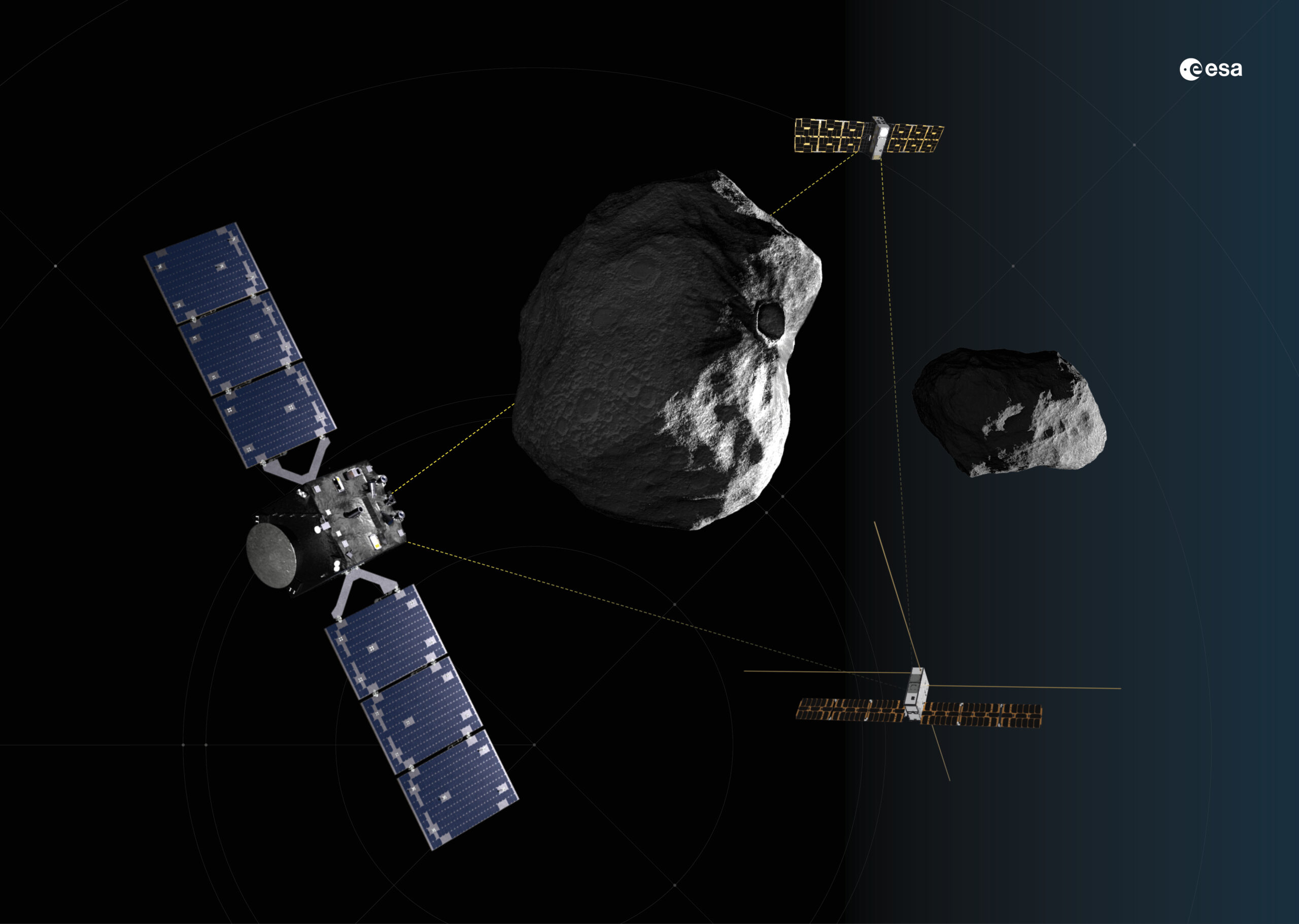
The distinction matters well beyond Dimorphos. Near-Earth asteroids come in many shapes, sizes, densities and makeups, and how much momentum a collision transfers depends on how the target holds together. The Didymos pair was chosen for the experiment precisely because it resembles many near-Earth asteroids while posing no risk to Earth; it currently orbits the Sun about 120 million miles away. Over the next six months Hera will close in and release two subsatellites, Juventas and Milani, to attempt landings and measure Dimorphos's composition, internal structure and mass — the numbers that anchor the models telling scientists how to deflect whatever comes next. "Once we understand, we have a breakthrough, which really solves planetary defense," Michel told Ars Technica.
The impactor was American; the forensics are European, and they arrive while two of NASA's four Mars spacecraft sit offline with technical faults. Juventas and Milani will attempt their landings on a rock still tumbling from its last visitor.