
Houthi forces mass 80km north of Aden
Yemen's temporary capital braces for assault after September's rout, Saudi bombing since then has killed or wounded 822 civilians including 181 children
Images
 Displaced women and children walk hand in hand near tents at a camp in Yemen.
theguardian.com
 People displaced by war on the Red Sea coastline receive aid near Aden, Yemen. Photograph: Reuters
theguardian.com
 Houthi forces take over from Dhubab to Bab el-Mandeb, Taiz governorate, Yemen, after Saudi-backed forces withdraw from the area, 16 November 2026. Photograph: Houthi Military Media/Reuters
theguardian.com
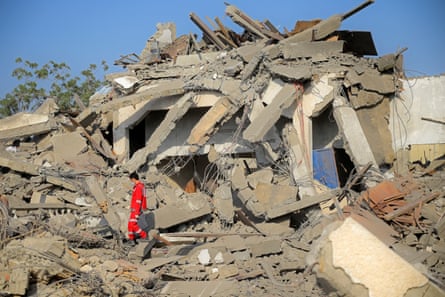 A rescuer walks through the debris of a destroyed building belonging to Yemen’s Public Telecommunications Corporation following a Saudi strike in the port city of Hodeida. Photograph: AFP/Getty Images
theguardian.com
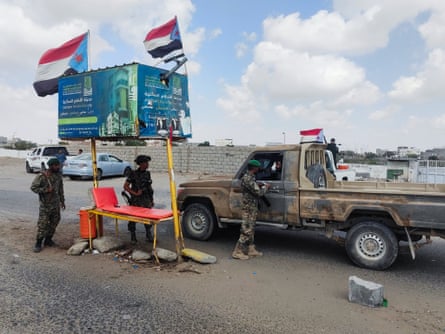 Members of the National Security Forces at a checkpoint as security is tightened in Aden. Photograph: Reuters
theguardian.com
Houthi fighters are massing about 80 kilometres north of Aden, and residents and aid organisations in the port city are drawing up evacuation plans. Aden has been the seat of Yemen's Saudi-backed government since 2015, and many of those now planning their escape have fled the Houthis once before.
"I fled my home in Sana'a and came here," Hussein, a schoolteacher identified by a pseudonym, told the Guardian. He arrived six years ago, when hundreds of kilometres of fortified territory still separated Aden from the front; in September the Houthis swept government forces aside anyway, and their fighters are now amassing to the city's north and east, beginning to encircle the territory the government still holds. A former member of the Islamist Islah party, Hussein expects persecution if they arrive. "The Houthis don't believe in freedom, they just want to hear one voice, the one they like."
The government has pulled fighters back from the south-western coast to hold Aden, trading the coast for the capital. This month Houthi forces took the ground from Dhubab to Bab el-Mandeb, on the Red Sea's southern entrance, after Saudi-backed troops withdrew. Saudi Arabia has answered with a renewed bombing campaign that has left, among other targets, a Yemeni telecommunications building in the port of Hodeida in debris. The independent Yemen Data Project counts 822 civilians killed and wounded in Saudi airstrikes since September, including 181 children; Houthi authorities count 5,500 Saudi air and missile attacks since July.
The bombing has not stopped the advance. Houthi troops are massing north of Kirish and in al-Bayda, ground from which Aden's northern and eastern roads can be cut. "The buildups in al-Bayda could threaten Aden's eastern road links through Abyan and Saudi supply lines into the city," said Mohammed al-Basha, founder of the US-based risk advisory Basha Report. "The Houthis appear to be testing how well Aden's defences will hold."
The war is in its twelfth year. Iran has armed and financed one side throughout it, Saudi Arabia has bombed that same side from the air throughout it, and the front has moved in one direction since September.
The Houthis have announced no intention of taking Aden. Hussein, who has already run from them once, has chosen his next way out: Marib, or Hadhramaut.