
Hybrid crabs outnumber snow crabs in Bering Sea survey
Crossbreeds carry no quota so fishers cannot land them, heatwave that killed ten billion crabs created the vacancy they now fill
Images
 A crab that is a hybrid of a tanner and a snow crab on top of a tanner crab. Marine biologists are not yet sure if the hybrids can reproduce with each other. Photograph: Erin Fedewa
theguardian.com
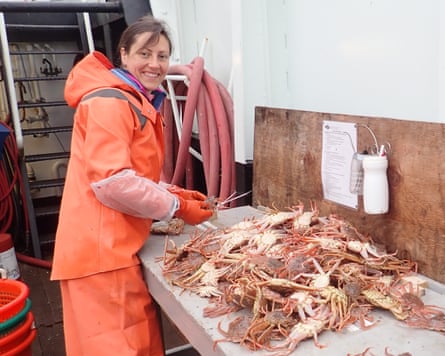 ‘Seeing all of these large male hybrids … was sort of like an affirmation for me,’ Erin Fedewa says of sorting through crabs by species. Photograph: NOAA Fisheries
theguardian.com
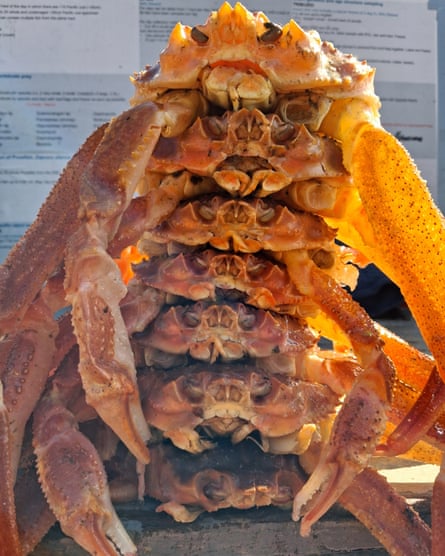 Hybrid crabs from this year’s NOAA survey of the Bering Sea. Fisheries are pushing for separate quotas for the hybrids. Photograph: NOAA Fisheries
theguardian.com
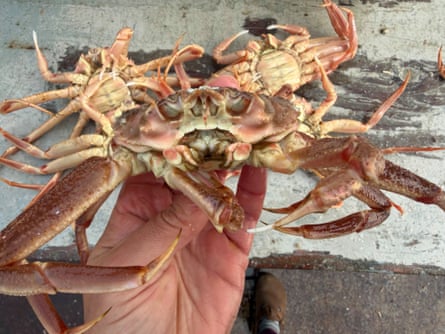 A hybrid crab from the Bering Sea. One marine ecologist has suggested that hybridisation might be much more common than is generally believed. Photograph: NOAA Fisheries
theguardian.com
When researchers aboard the trawler Alaska Knight hauled up their first catch of the summer survey, hundreds of miles off the coast of Alaska, the heap of crabs on deck looked wrong. Instead of the usual species, the catch was dominated by hybrids between snow crab and tanner crab — squashed M-shaped mouths between the snow crab's flat mouth and the tanner's distinctive M, one red eye and one green. The 2026 survey found that commercially sized hybrid adult males now outnumber snow crabs in the Bering Sea. None of the hybrids can be landed, because the quota system has no category for them. As the Guardian's headline puts it: legally, they don't exist.
The trigger was the marine heatwave of 2018 and 2019, when the Bering Sea was nearly ice-free by early spring. Mass starvation killed roughly ten billion snow crabs — one of the largest marine mass mortality events ever recorded. Early signs appeared in 2019 and became shockingly obvious by 2021, with the 2020 survey cancelled during Covid. The snow crab fishery was closed from 2022 to 2024, at a cost of hundreds of millions of dollars.
The collapse opened the water for the hybrids. Snow crabs compete with them for the same resources and may also feed on younger crabs, and a study by Erin Fedewa and her colleagues found that the absence of snow crabs allowed the hybrids to flourish. In the overlap zone between the two species' ranges, hybrids were historically a rarity; in 2025 researchers recorded more than thirteen times as many as the historical average, and this summer's survey confirms the trend. Fedewa, a biologist at NOAA's Alaska Fisheries Science Center, told the Guardian her first thought on grasping the scale of the surge was: "This is going to be such a headache for fisheries management."
The headache is built into the machinery. The science centre has run yearly surveys since the 1980s to assess commercially important species — walleye pollock, Pacific cod, snow crab, tanner crab — and the results feed population models that fishery managers use to set quotas. A quota is a number attached to a species. A crab that is half of one and half of the other attaches to no number, so the crab now outnumbering snow crabs in commercial sizes cannot be allocated to anyone, and what swims into the pots cannot come ashore.
In the years after the collapse, snow crabs showed signs of bouncing back. The most recent survey found the recovery had stalled, with decreases in some size categories — whether the hybrid boom has anything to do with that, the scientists do not know. Nor is it established whether the hybrids can reproduce with each other. The quota system, for its part, has already settled what they are: nothing.