
Russian missiles and drone crash in NATO-member Poland during massive overnight strike on Ukraine
Tusk calls it intentional provocation on the eve of allied exercises, Rutte visits Warsaw as debris lands 50 kilometres from the drills
Images
 A security camera view shows an explosion in the distance after an unknown object fell near the Ukrainian border, in Aleksandrów, Poland. Photograph: Social Media/Reuters
theguardian.com
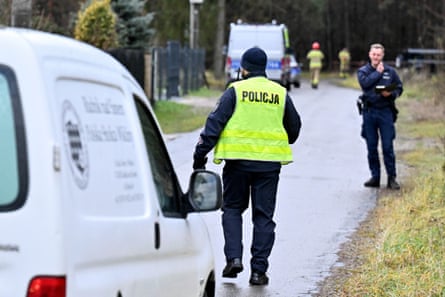 Security personnel secure the area after reports of a possible unidentified object falling in Rudnik nad Sanem, south-eastern Poland. Photograph: Piotr Polak/EPA
theguardian.com
Two Russian cruise missiles and a jet-powered drone crashed in south-eastern Poland overnight during one of the largest Russian air attacks on Ukraine since the full-scale invasion in 2022. Polish defence minister Władysław Kosiniak-Kamysz confirmed three violations of Polish airspace, with objects falling near Nowy Lipowiec, Mołodycz and Rudnik nad Sanem — all between 30 and 60 miles from Nowa Dęba, where troops from eleven countries in the 'coalition of the willing', including the UK, had gathered for exercises.
The strike came the night before the drills were due to begin, a timing that neither Warsaw nor Nato's secretary general treated as chance. Donald Tusk called the incident an intentional provocation and said Mark Rutte, who will visit Warsaw on Saturday, agreed it did not seem coincidental. Rutte wrote on X that the violations were clearly dangerous and a consequence of Russia's ongoing war. Nato jets were scrambled in response.
The scale of the attack itself was considerable. Maj Gen Ireneusz Nowak, commander of Poland's operational command, said Russia used seven bombers, firing 26 Kalibr cruise missiles, 72 Kh-101 cruise missiles and more than 500 drones. As many as eleven objects were identified as dangerous to Polish airspace. In Ukraine, at least eight people were killed and nearly thirty injured, and Volodymyr Zelenskyy said all the targets were ordinary civilian infrastructure, spread across many cities and regions.
The strike landed days after Vladimir Putin met Donald Trump and Xi Jinping, and Zelenskyy argued Putin proceeded anyway — attempting, in his words, to compensate for military and diplomatic impotence with terror. UK defence secretary Wes Streeting, in Poland for the exercises, described the incursion as very serious, noting the impact of Russia's war is increasingly being felt in neighbouring countries.
For Nato, the incident reopens the question the alliance has spent four years deferring: what happens when Russian weapons physically land in member territory. No one was injured this time, and the debris will be examined, but the mechanism for turning airspace violations into a collective response remains undefined. Tusk, for his part, used the moment to press a political claim — that Poland must participate in decisions on Ukraine's future, since Warsaw understands the Russian threat better than most.
The exercises at Nowa Dęba proceed as planned, with eleven allied contingents on the ground and Russian wreckage scattered across the countryside roughly fifty kilometres away.