
Almost no national flag contains purple
Tyrian dye from sea snails cost more than gold and was reserved for emperors, cheap synthetic purple arrived in 1856 after most flags were already locked in
Images
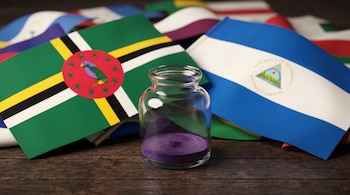 Un frasco de vidrio con polvo morado sobre una mesa de madera junto a banderas de Dominica, Nicaragua y otros países.
infobae.com
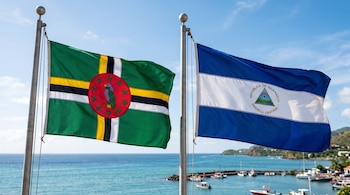 Banderas de Dominica y de Nicaragua en mástiles metálicos ante una bahía marina con botes y colinas bajo un cielo despejado.
infobae.com
Purple is the least used color in the world's national flags, and the reason has nothing to do with aesthetics. For most of recorded history, purple dye was simply too expensive to paint onto cloth that had to be produced in quantity, replaced after weathering, and flown from ships, according to a survey of the historical record compiled by Infobae.
The origin of the problem lies in Tyrian purple, the pigment of the ancient eastern Mediterranean. It was extracted from the secretions of sea snails of the genus Murex, and the process was brutal in its arithmetic: according to records compiled by the Smithsonian, thousands of snails were required to dye a single tunic. The price followed the arithmetic. Purple became the color of Roman emperors and, later, monarchs — not because anyone legislated it, but because the only people who could afford it were the only people who could afford anything they wanted.
A flag, unlike a ceremonial robe, is a consumable. It demands fabric, dye and periodic replacement, especially in military and maritime use where sun, salt and wind destroy material at a steady rate. Insignia that must be reproduced cheaply and at volume will be made from whatever colors are cheap and abundant — red, blue, white, yellow, green. Vexillology, the study of flags, thus records a supply chain rather than a design tradition.
The availability problem was solved in 1856, when the British chemist William Henry Perkin accidentally discovered mauveine while attempting to synthesize quinine. According to the Encyclopaedia Britannica, mauveine became one of the first commercially successful synthetic dyes and opened the way to industrial production of violet tones. Clothing and everyday objects adopted the color.
Flags did not, for two reasons. First, most national symbols were already fixed by the time cheap purple existed, and states tend to preserve established designs. Second, the color carried a symbolic burden — royalty, nobility, empire — that was actively uncomfortable for nations born from independence movements. A country that had just fought its way out of a monarchy was not going to fly the monarchy's color, whatever it cost.
The modern exceptions prove the pattern by their modesty. Dominica's flag, adopted in 1978, contains purple only in the plumage of the sisserou parrot at the center of its coat of arms. Nicaragua's flag confines the color to the rainbow of its national emblem. The often-repeated claim that exactly two flags contain purple depends on how coats of arms and printing details are counted, but no state has ever given purple a stripe of its own.
Nations that could today afford purple by the kilometer keep flying combinations settled when they could not, copied from neighbors whose flags were settled when they could not either. The colors on the world's flagpoles record what snails and emperors made expensive, not what any designer chose.