
Rafael Behr: Trump Xi and Putin share a vision of global power with no place for Europe
Continent that outsourced its security to Washington now watches its patron negotiate with the rival it was armed against, Yalta analogy recalls partitions paid for in European territory
Images
 Donald Trump hosts China’s president, Xi Jinping, at the White House in September 2026. Photograph: Kevin Dietsch/Getty Images
theguardian.com
 Rafael Behr
theguardian.com
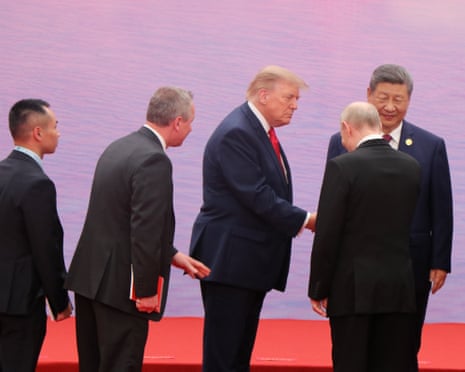 Donald Trump greets Vladimir Putin and Xi Jinping before a dinner at the Apec summit in Shenzhen on Wednesday. Photograph: Emre Aytekin/Anadolu/Getty Images
theguardian.com
The leaders of the United States, China and Russia met as a trio for the first time on Thursday, on the sidelines of the Apec summit in Shenzhen. The encounter was scheduled to run for less than an hour. Rafael Behr writes in the Guardian that the guest list is the story: three men with a shared vision of global power, and a continent that is not in the room.
For eighty years, Behr notes, European security has been outsourced to Washington — armed by one superpower against another, on the assumption that the patron would never sit down with the rival. In Shenzhen it has done exactly that. Beijing announced themes of 'safeguarding world peace' and 'promoting strategic stability in major-power relations'; Donald Trump listed denuclearisation, Iran, trade and 'my favourite subject, Ukraine'.
The comparison being drawn across European commentary is Yalta, the February 1945 conference at which Roosevelt, Stalin and Churchill drew up plans for postwar Europe. Behr handles the analogy carefully — Yalta was a week-long conference among military allies settling the fate of a defeated enemy — but the memory that endures is of a cynical partition that condemned eastern European nations to decades of Soviet captivity. Great-power settlements have historically been paid for with European ground.
Ukraine's European allies have asserted their right to a place in any peace process. At the Abu Dhabi round last week, Trump's envoy Jared Kushner said no deal could be done 'without Europeans being at the table'; Russia's chief negotiator Vladimir Medinsky dismissed the European delegation as 'tourists' who might as well 'chat in the hotel bar'. Vladimir Putin, who never forgave Barack Obama's 2014 description of Russia as a 'regional power', has built two decades of politics on that resentment, and gloated, as the Guardian's editorial notes, about Europe's 'humiliation' in the run-up to the summit. Kyiv fears he will use his access to Trump to sell a narrative of Nato provocation and irresistible Russian superiority — and that Europe will be told it is wasting money and American hardware on a losing cause.
Behr's argument ends with the audience at home. European leaders continue to recite the 'rules-based order' to publics that have stopped listening, because the recital is what remains of a position never backed by a seat at the table. The paper's editorial, published alongside, observes that all three governments are undermining multilateralism even as they praise stability. The continent that could not produce a single figure of diplomatic gravitas to coordinate its claim now watches its fate discussed in a city chosen to showcase China's economic and technological progress.
The agenda was never detailed beyond the announced themes. The meeting was scheduled to run under an hour.