
EU aims to triple data centre capacity within seven years
Protesters in eight countries demand freeze on new projects, ambition to escape US Big Tech meets soaring power prices and net-zero scepticism
Images
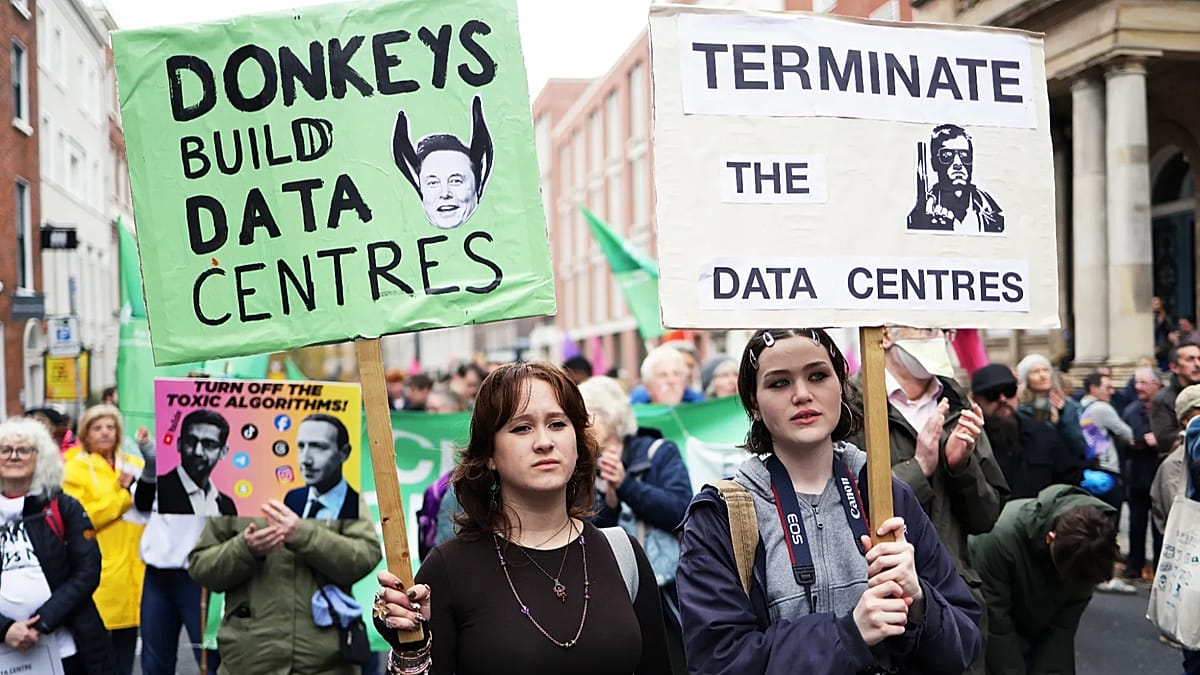 Should Europe triple or freeze its data centre capacity?
euronews.com
The European Union has set itself the ambition of tripling its data centre capacity within five to seven years, part of an effort to reduce reliance on US Big Tech and build the continent's own AI capability. In the same week, residents and environmental campaigners took to the streets in Ireland, Poland, Denmark, Finland, Spain, the Netherlands, France and the United Kingdom to demand a freeze on new data centre projects.
Owen Espley, coordinator of Stop Dirty Data Centres.eu, lists the concerns: "the impact on land, on water, the huge energy use that data centres demand, as well as the impact that that energy use could take away from housing." The European Data Centre Association, the industry's representative body, sits on the other side of the argument.
The collision is arithmetic as much as politics. The EU has promised to be the world's first climate-neutral continent by 2050, and EU ministers insist the green transition continues despite soaring energy prices and supply concerns. The publics being asked to carry both agendas are not convinced. In the Netherlands, 76 per cent of people consider it unlikely their country will make meaningful progress towards net zero; in France 72 per cent agree, in Germany 68 per cent. Fifty-four per cent of people in the Netherlands say environmental policies have left ordinary people worse off. Voters want cheaper energy now, while many of the measures designed to deliver it will take much longer to pay off.
The ambition also runs into the geography of AI capital. The European Central Bank warned this week that the AI investment boom is concentrated on the other side of the Atlantic, with European savers bearing the risk while the capital investment stays in the United States. Europe's answer is to build the compute at home — and to power it from grids already strained by soaring prices and supply concerns.
Sven Haremling, head of climate at CAN Europe, offers the one proposition that the polling suggests voters no longer accept on faith: "People also appreciate it if they're told the truth and what needs to change, as long as there's someone who works with them for solutions and there are changes in government regulations."