
Asháninka militias fight Peru's cocaine gangs with bows and old guns
Lima armed the ronderos against Shining Path rebels in 1991 but sends nothing against traffickers, volunteers still man the sandbag posts the army built above the Tambo River
Images
 Asháninka ronderos, or volunteers in the self-defence committee militias, many armed with traditional bows and arrows, were crucial in defending their communities during the bloody Shining Path conflict. Photograph: Rowan Glass
theguardian.com
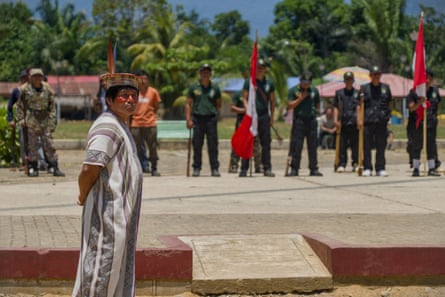 Kiri, the nom de guerre of Irmeo Sánchez Gómez, with his volunteer ronderos at the Central Asháninka del Río Tambo (Cart) anniversary. Photograph: Rowan Glass
theguardian.com
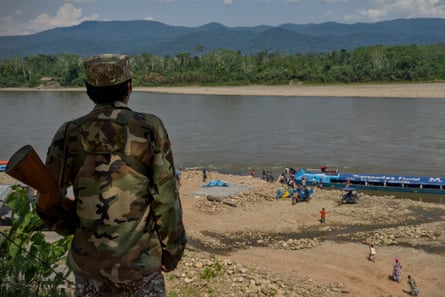 A rondero on sentry duty as people arrive for the Cart meeting. Photograph: Rowan Glass
theguardian.com
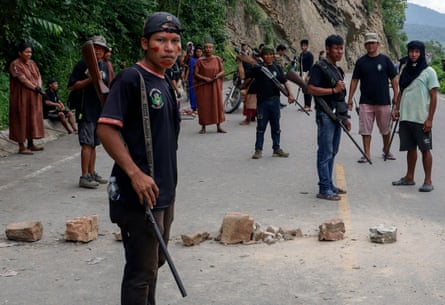 Armed Asháninka men block a road in Junin in 2023 to demand government protection after the murder of one of their leaders by alleged drug traffickers. Photograph: Christian Sierra/AFP/Getty
theguardian.com
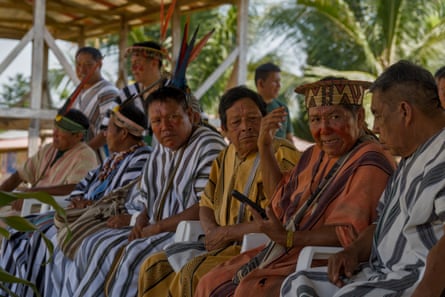 Self-defence veterans, who lived through the height of Peru’s conflict in the 1980s and 90s, are held in high esteem in the Tambo region. Photograph: Rowan Glass
theguardian.com
Three ronderos in partial military fatigues watch the Tambo River from a hilltop post near Poyeni, shotguns over their shoulders. They are Asháninka volunteers in the self-defence committees that the Peruvian Amazon's most populous Indigenous group raised in the 1980s against the Shining Path; the enemy today is cocaine traffickers. The Peruvian state, which once armed these militias, has sent nothing for the new war.
The committees — Cads — emerged as a grassroots answer to the Maoist guerrillas whose insurgency turned the Asháninka's rainforest into a battlefield between 1980 and 2000. Of roughly 55,000 Asháninka, an estimated 6,000 were killed, 10,000 forcibly displaced and 5,000 taken captive. The Cads defended communities and rescued captives at the height of the violence, first with bows and arrows. "If our arrows didn't kill them, the poison did," says Irmeo Sánchez Gómez, known as Kiri, who joined the first committees as a teenager and now leads Poyeni's.
Lima's help arrived only in 1991, when Alberto Fujimori's legislative decree 741 formally recognised the committees and granted them military aid. The army trained the ronderos and supplied munitions, and in the Tambo basin the military presence aided the fight, as the anthropologist Mariella Villasante Cervello notes. The price was what the anthropologist Orin Starn describes as a permanent tension between community initiative and military control — "plenty of manipulation and control from above," though he cautions against dismissing the committees as army puppets.
The guerrilla war ended; the cocaine economy that grew in its place did not, and the aid did not follow it. Decades after Lima armed the committees against the Shining Path, the Asháninka are still defending the same riverbanks — now against traffickers, and without any help. The machinery built for one war is being reused for another: delegations from dozens of communities recently arrived by boat for the 47th meeting of the Central Asháninka del Río Tambo, which represents the basin's 52 communities and helped found the committees in the first place.
The arrangement is Peru's security situation in miniature. Where the state withdraws, someone else supplies protection — on the coast, kidnapping gangs calibrate ransoms to what a household can borrow; on the Tambo, the protection is supplied free, by the same unpaid volunteers who supplied it against the guerrillas.
On the hill above Poyeni, the shed the army built still stands, sandbags frayed at its base. The army built the defences; the ronderos still staff them.