
Israel uploaded millions of Palestinian photos to Amazon's facial recognition platform
Leaked documents show 3.5 million images moved to a datacentre near Tel Aviv, Gaza checkpoints served as pop-up surveillance posts
Images
 aws israel collage
theguardian.com
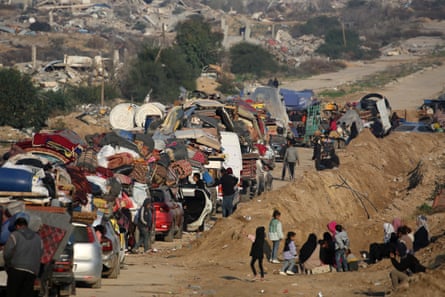 Displaced Palestinians wait to cross a checkpoint in Mughraqa in central Gaza in January 2025. Photograph: Eyad Baba/AFP/Getty Images
theguardian.com
 Amazon founder Jeff Bezos speaks at the America Business Forum in Miami last year. Photograph: Rebecca Blackwell/AP
theguardian.com
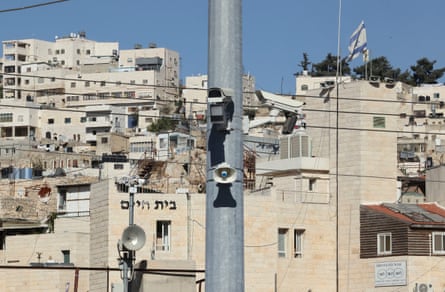 A surveillance camera is pictured at a checkpoint in the Palestinian city of Hebron in 2021. Photograph: Hazem Bader/AFP/Getty Images
theguardian.com
The Israeli military uploaded 3.5 million photographs of Palestinians to Amazon's cloud so it could run facial recognition across them, according to leaked documents obtained by the Guardian in an investigation by Harry Davies and Yuval Abraham. The catalogue was moved during the early months of the bombardment and ground offensive in Gaza.
The images were transferred to an Amazon datacentre near Tel Aviv by a military department commonly known as Rolling Stone, which sits inside a software unit and takes its name from the system that serves as the army's central repository of information on Palestinians living in Gaza and the West Bank. The department informed Amazon in early 2024 that the images would sit on its servers so it could use Rekognition, Amazon's AI-powered image-analysis platform, for a facial recognition project.
After the ground invasion of October 2023, soldiers routinely photographed Palestinians as they passed through checkpoints, often people freshly displaced by the bombing, and a military source familiar with the work told the Guardian the cloud was used because of the "very large scale" of images collected at the sites. The checkpoints, the documents show, effectively served as pop-up surveillance posts. It is not clear whether the 3.5 million images were taken at them. In the West Bank, face scanning is routine at the crossings and soldiers collect images through custom-built smartphone apps. In recent years Israel has also migrated huge volumes of data, including sensitive intelligence material, into Amazon's datacentres.
The platform had another use at the war's start. Early in the campaign, the military used Rekognition to identify hostages taken in the Hamas-led attack of 7 October 2023, and to flag people it suspected were militants. The New York Times has previously reported that commercial facial recognition systems tested in Gaza, scanning faces in crowds and in drone footage, at times wrongly flagged civilians as militants.