
Qatar and Turkey sign mutual defence pact
Gulf states diversify security suppliers as Washington starts charging by the hour, Mecca agreement joins NATO's second-largest army to Pakistan's nuclear arsenal
Images
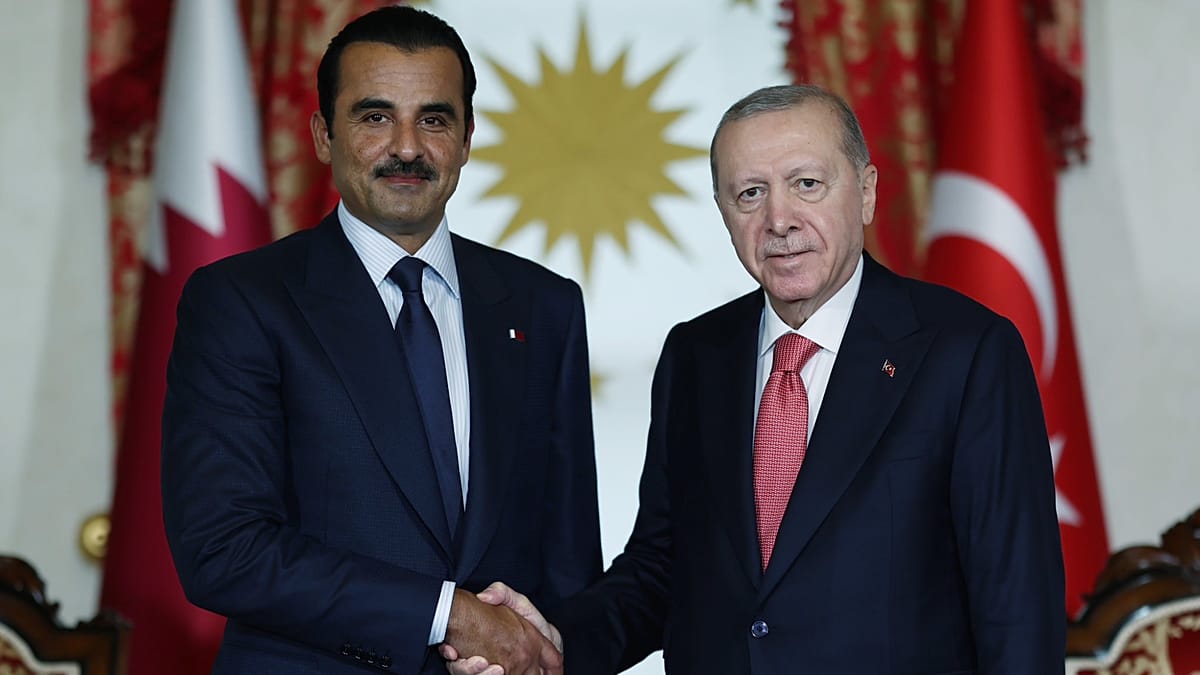 Qatar and Turkey announce a landmark defence alliance
euronews.com
Turkey and Qatar signed a mutual defence agreement in Istanbul on Friday, pledging what a joint statement called 'a unified position in the face of any external armed attack targeting either or both parties'. The deal, concluded at a Supreme Strategic Committee meeting co-chaired by President Recep Tayyip Erdogan and Emir Sheikh Tamim bin Hamad Al Thani, covers joint military exercises, defence-industry cooperation and personnel training exchanges. Erdogan's office said it would 'add a new dimension to the brotherly ties between the two countries'.
The pact completes a pattern that has assembled itself over barely three months. In August, Turkey, Pakistan and Saudi Arabia signed the Mecca Joint Defence Agreement — a collective-defence clause under which each comes to the others' aid if attacked, ratified by the Turkish parliament only last week. Pakistan and Kuwait signed their own cooperation agreement the same month. In October, Qatar, Turkey, Pakistan and Indonesia signed the 'Badr' memorandum on defence-industry cooperation. Turkey brings NATO's second-largest military; Pakistan brings the Muslim world's only nuclear arsenal; the Gulf states bring the money.
The driving force is not stated in the communiqués but is visible in everything else on the region's ledger. The agreements follow the Iran war and, as Euronews notes, US signals that it is adapting its long-standing security presence — a euphemism that now includes an American president demanding that allies pay for protection and complaining publicly about voters who balk at war's costs. Qatar and the UAE have said plainly that the Gulf cannot rely on the United States alone.
Friday's signing session was not only military. Erdogan and the Emir also concluded agreements on trade, energy, diplomacy, education and culture, and discussed Israeli attacks on Gaza, normalisation efforts in Syria and developments in Libya. Erdogan said the two countries would work to prevent war resuming in the Gulf.
Turkey has said the Mecca agreement targets no third country and remains open to other states, including Egypt — a formulation that leaves the subscription list open for exactly as long as Washington's billing practices do.