
Native oysters breed again in Scottish firth after century of local extinction
Victorian dredging emptied beds that landed 30 million a year, surviving fishery owes its stock to a royal charter
Images
 Marine biologist Gurjameer Ramday (left) and Prof William Sanderson with two-year-old oysters in quarantine tanks at Heriot-Watt University that will eventually be released in the Dornoch Firth. Photograph: Murdo MacLeod/The Guardian
theguardian.com
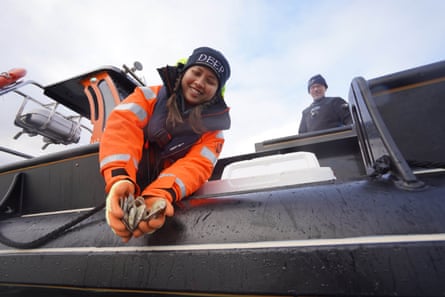 Aisyah Wan and Prof Bill Sanderson release oysters into the Dornoch Firth. Photograph: Dornoch Environmental Enhancement Project
theguardian.com
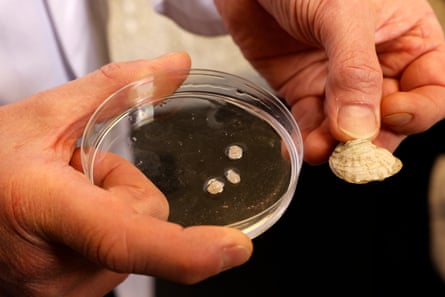 Juvenile flat oysters found in July. The ones still in the Dornock beds have now grown to the size of the larger example. Photograph: Murdo MacLeod/The Guardian
theguardian.com
Marine conservationists have confirmed the first successful wild breeding of native oysters at a British site where the species had been locally extinct for more than a century: the Dornoch Firth, north of Inverness. Around four million European flat oysters are expected to colonise the restoration site in the coming years.
The native oyster was not always rare. Victorian charts, including Olsen's Piscatorial Atlas of 1883, recorded billions of them crowding the British seabed in reefs that supported rich marine ecosystems. The Firth of Forth bed alone ran twenty miles long and six wide; at its Victorian peak it landed 30 million oysters a year, shipped in bulk on the new railways to feed expanding cities. Within decades, dredging had fished the beds out across the North Sea, the Channel and countless coastal fisheries — and only when the stocks collapsed did legal restrictions on taking wild oysters arrive. Today the native oyster appears on lists of critically threatened species, and the vast majority of oysters sold in British shops and restaurants are farmed Pacific oysters.
Only a handful of sites around the British coast still hold substantial wild beds. One of them, Loch Ryan near Stranraer, carries an estimated 23.5 million oysters under a royal charter and sustains an annual oyster festival — and it is from there that the Dornoch Environmental Enhancement Project, known as Deep, has harvested its stock. Twelve years in and co-funded by the Glenmorangie whisky company, Heriot-Watt University and the Marine Conservation Society, Deep has deposited about 140,000 hand-cleaned adult oysters in the firth. Prof Bill Sanderson, the Heriot-Watt marine biodiversity professor who leads the project, called confirmation that the oysters are now reproducing naturally "a very significant milestone."
The shellfish are not the whole point. Oysters are ecosystem engineers: they fix sediments, filter the water, build carbon stores and shelter hundreds of species. "When you establish an oyster reef, it's very likely that over a decade you're going to double the diversity on the seabed," Sanderson said. Around a dozen newer restoration projects across Europe are watching Deep's results.
The baby oysters now settling the Dornoch Firth are the size of a 50-pence piece. The Firth of Forth reef that dredging erased was twenty miles long.