
Greenpeace boulders land on Norfolk Vanguard windfarm site, £12 billion North Sea project surveys must be redone after 15 tonnes of stones dropped without marine authority consent
Campaign against trawling is paid for out of the windfarm's schedule
Images
 Boulders weighing up to 2 tonnes being dropped onto the seabed in the North Sea by Greenpeace Photograph: Andrew McConnell/PA
theguardian.com
 Greenpeace campaigners drop boulders onto the seabed to create anti-trawler barrier
theguardian.com
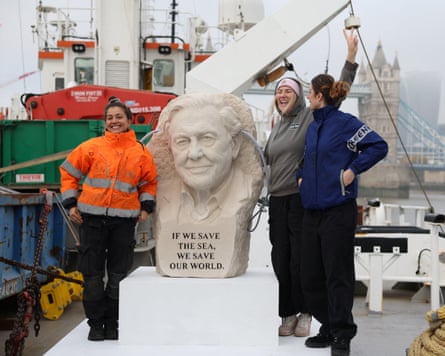 Greenpeace crew and activists next to a boulder with a carved depiction of David Attenborough while aboard the Greenpeace ship Arctic Sunrise this month. Photograph: Suzanne Plunkett/Reuters
theguardian.com
Greenpeace activists dropped roughly 15 tonnes of boulders — each weighing up to two tonnes — onto the seabed off the Norfolk coast, and most landed on the site earmarked for Norfolk Vanguard, one of the UK's largest planned offshore windfarms. The £12 billion project, backed by the UK government with a £1 billion public stake believed to be the biggest of its kind in British history, is due to begin construction next year.
The boulders were dropped without consent from the marine authority as part of a campaign against bottom trawling in one of the southern North Sea's most heavily trawled areas. Greenpeace checked the seabed for cables, pipelines and shipwrecks before dumping — but was, it says, unaware of the Vanguard East windfarm plans. Some stones bear the signatures of celebrities including Simon Pegg and Benedict Cumberbatch; the action was timed to the premiere of the BBC's Blue Planet III, narrated by Sir David Attenborough, whose carved likeness rode aboard the Greenpeace ship Arctic Sunrise.
RWE, the German utility developing the windfarm, is now in talks with Greenpeace to verify the boulders' exact placement so it can update seabed surveys begun last summer, and is investigating potential impacts on construction and undersea cables. The company describes the communication as 'constructive'.
Will McCallum, co-executive director of Greenpeace UK, called any suggestion that the boulders posed a genuine obstacle 'absurd', noting that developers routinely move naturally occurring boulders from the seabed — some ten times heavier than Greenpeace's — before building. He added that Greenpeace has long championed offshore wind, and that the boulders will protect the area from trawlers while construction proceeds. The stones are expected to be removed within months.
The dump landed days before the prime minister told the Cop31 summit that the UK would invest public money in Vanguard West and Vanguard East. Environmental clearances for a £12 billion project can absorb a few months of obstruction; the interest clock on the capital does not pause while the stones wait to be counted.