
First Trump-Xi-Putin summit expected at Apec in Shenzhen
Ukraine, eastern Europe and Taiwan left outside the room, Zelenskyy warns of a second Yalta
Images
 A painting depicting Donald Trump, Vladimir Putin and Xi Jinping is unveiled in St Petersburg, Russia. Photograph: Dmitri Lovetsky/AP
theguardian.com
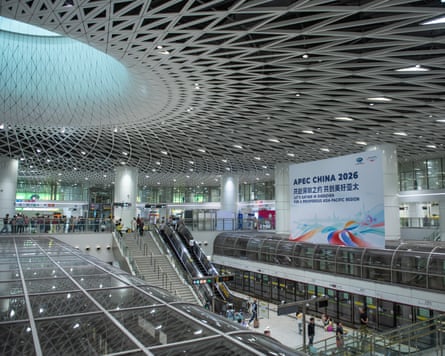 The three world leaders are expected to hold a meeting on the sidelines of the Apec summit in Shenzen. Photograph: Yin Haixiang/VCG/Getty Images
theguardian.com
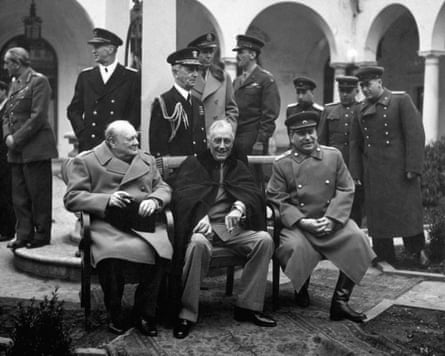 Winston Churchill, Franklin D Roosevelt and Joseph Stalin at the Yalta summit in 1945, where the postwar world was shaped. Photograph: Fine Art Images/Heritage Images/Getty Images
theguardian.com
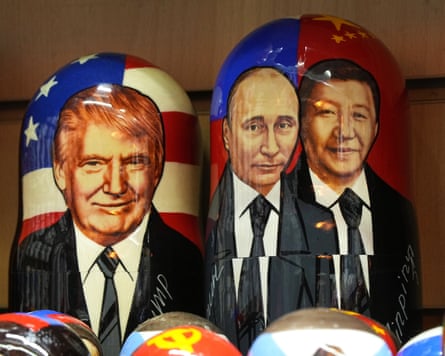 Trump, Putin and Xi as matryoshkas, the traditional Russian wooden dolls. Photograph: Dmitri Lovetsky/AP
theguardian.com
Donald Trump, Xi Jinping and Vladimir Putin are expected to meet trilaterally on the sidelines of the Apec summit in Shenzhen this week, a three-power format the Kremlin has sought for years. The guest list is the story: Ukraine, the eastern European and Baltic states, Taiwan and Iran are all left outside the room. Volodymyr Zelenskyy is among those warning that the world may be about to witness a 'Yalta 2.0' moment, the Guardian reports.
Yalta, in February 1945, was eight days at a rundown Tsarist resort on the south coast of Crimea, where Stalin, Roosevelt and Churchill divided the continent their armies had conquered. Roosevelt, months from death, wanted Russian support for his new League of Nations and Russian entry into the war against Japan; in exchange he accepted the fait accompli of Russian troops in Poland. Stalin signed a declaration affirming 'sovereign rights and self-government' for countries freed from Nazi rule, and few at the time believed he meant to honour it. Outside Russia, Yalta became a byword for betrayal, its ignominy rivalled only by Munich in 1938.
Putin's negotiators are not shy about the precedent. 'The task is to create a comprehensive system of comprehensive security in Europe that will become a new modern Yalta or Potsdam,' Vladimir Medinsky, Russia's chief negotiator, told Russian television. 'If we manage to create such a security system then we will ensure peace in Europe for decades, perhaps even centuries. That is our main task.' A new security architecture for Europe, drafted by three capitals while the Europeans it concerns wait outside. Foreign ministry spokeswoman Maria Zakharova casts the meeting as 'the start of a return from this slide into absolute chaos to stabilisation'.
Russia's economy is seven times smaller than that of the EU, but the format treats Moscow as an equal architect of world order. Both Washington and Moscow arrive asking Beijing for help in extricating themselves from wars of choice. Trump has cast himself as the enthusiastic guest; Xi plays the bashful host, reluctant to embrace the status of a traditional global superpower. China is already pushing nuclear disarmament off the agenda. Putin aims to make Shenzhen the first in a series of meetings in which the big powers organise a new world order on security-oriented principles in which liberal values play little part.
Zelenskyy's concern, according to the Guardian, is that almost any time Putin and Trump converse, it is Kyiv that suffers. Whether Shenzhen produces more than a stiff, protocol-driven exchange of statements is not yet known. In St Petersburg, a painting depicting Trump, Putin and Xi has already been unveiled.