
Central European University reaches back toward Budapest, Soros-founded institution forced to Vienna under Orbán now courts Péter Magyar's government
US applicants up since Trump targeted elite universities
Images
 Demonstrators at a ‘We stand with CEU’ protest in Budapest in 2018. Photograph: Zsolt Szigetváry/EPA
theguardian.com
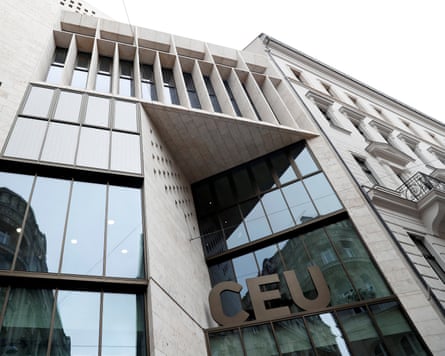 CEU’s main building in Budapest, pictured in 2018. Photograph: Bernadett Szabó/Reuters
theguardian.com
Three hundred and twelve employees still work out of the Central European University's offices in Budapest — mostly administrative staff left behind when the institution moved its teaching to Vienna in 2019. Now the university says it wants to expand in the Hungarian capital again, under a new government that has promised to restore academic freedom.
"We are a great asset, so let's work out something," interim rector Carsten Q Schneider told the Guardian, while insisting that CEU wants no special treatment. No formal talks have yet been held with the government of Péter Magyar, who won a landslide on pledges to root out corruption and reform the state. "Our hand is reaching out, their hand is reaching out — it is just that they have many things to do," Schneider said.
The overture would partially reverse the expulsion that turned CEU into a European cause célèbre. The university was founded in 1991 by the Hungarian-American financier George Soros to entrench democratic change in the region, and a law widely seen as targeting it forced CEU to stop awarding degrees in Budapest. The EU's highest court struck the law down in 2020 for violating the bloc's charter of fundamental rights — a verdict that arrived a year too late to keep the institution in place.
The exile, meanwhile, has paid. Schneider describes CEU as "thriving tremendously" in Vienna, where 476 staff and all of the teaching are now based, serving more than 1,400 students from 103 countries. For the first time, the largest cohort of master's students is American — 10 percent — and applications from the United States have risen since Donald Trump returned to the White House and opened his campaign against elite universities, cutting federal funding and seeking control over internal policies. The rector has been holding informal talks with US academics about how universities survive rightwing governments; his advice is blunt: "Don't be naive for a second. These people have a plan, so it's not by accident that they attack universities. They want to have cultural hegemony." Yet he concedes that Trump and allied movements such as Germany's Alternative für Deutschland have identified "real problems" — among them, in his telling, the entrenchment of "a reproduction of elites" at American universities.
No wholesale return is on the table. Any expansion must not damage the student experience — a student combining economics and history should not have to shuttle the 200-plus kilometres between Vienna and Budapest — and an upgraded Budapest presence would amount, he said, to a symbol of academic freedom and of resilience. It would also depend on goodwill and on funding independent of the Hungarian government. The decision rests with CEU's thirteen-member board, which includes the founder George Soros and his son Alexander.