
Europe's Hera spacecraft begins close survey of asteroid moonlet NASA rammed in 2022
ESA probe measures the orbit change and prepares shoebox CubeSats to land on Dimorphos, impact debris may still be in the vicinity
Images
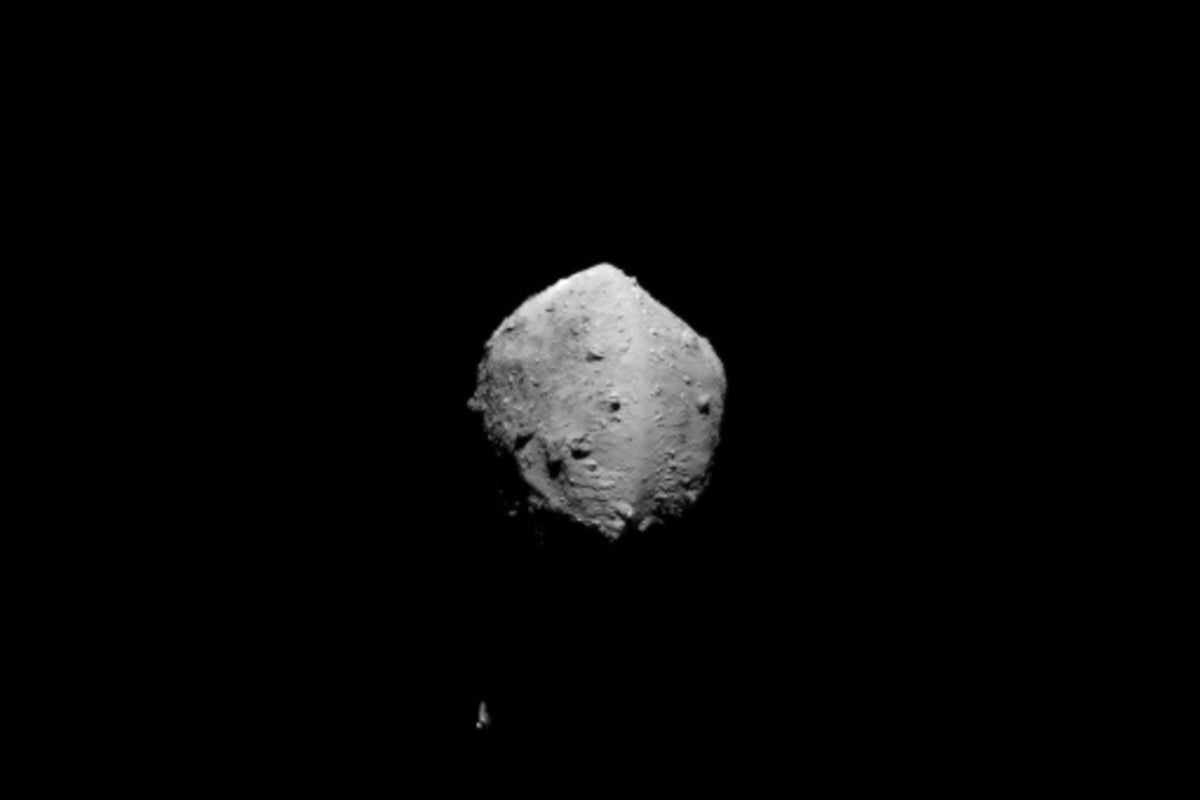 Europe's Hera spacecraft begins close inspections of an asteroid rammed by NASA in a 2022 test
independent.co.uk
Europe's Hera spacecraft has begun close inspections of Dimorphos, the asteroid moonlet NASA's DART probe deliberately rammed in 2022, the European Space Agency announced on Wednesday. Hera is observing Dimorphos and its parent asteroid Didymos from roughly 25 to 30 kilometers away, the Associated Press reports, and will close to about 20 kilometers next month.
The Double Asteroid Redirection Test struck Dimorphos to find out whether such a nudge could one day save Earth from a dangerous space rock. The impact shortened the moonlet's orbit around Didymos and pushed it onto a slightly different path around the sun. It also blasted rubble and boulders off the surface — debris that gave the collision extra momentum — and left a trail stretching more than 10,000 kilometers into space for months. Scientists say some of that debris may still be in the vicinity, which makes Hera's approach a mapping exercise as much as a measurement.
Hera is car-sized, launched in 2024, and carries 25 science instruments along with two shoebox-sized CubeSats that will survey Dimorphos at close range and attempt to land on it. The target is modest as asteroids go: Dimorphos measures about 151 meters across, its parent Didymos about 780 meters.
Planetary defense is the corner of space activity with no commercial counterpart. No insurer prices asteroid impact risk and no customer pays for a deflection demonstration, so the follow-up work — establishing exactly what the 2022 impact did, and whether the models that predicted it held — fell to a public agency. Washington provided the collision; the European agency is providing the forensics.
The stakes of the measurement are plain. If Hera's data show the orbit change matches what physicists expected, humanity has for the first time a demonstrated method for moving a threatening rock. If the numbers tell a different story, the models get corrected before anyone needs them in earnest.
Next month, Hera's CubeSats attempt to land on a moonlet whose own debris may still be drifting nearby.