
Millions join Spain's first general strike in 14 years
Tenants' associations lead stoppage over rents up 80 percent in a decade, walkout comes weeks before election that could bring far right to power
Images
 Trade union members protest in Barcelona. The strongest support for the general strike was reported in coastal regions such as Catalonia and Andalusia, where the soaring cost of housing been particularly acute. Photograph: Josep Lago/AFP/Getty Images
theguardian.com
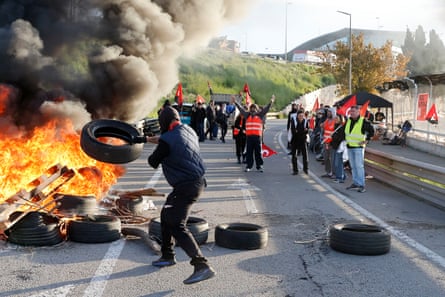 Protesters set fire to tyres at a roadblock on Wednesday in Barcelona. Photograph: Andreu Dalmau/EPA
theguardian.com
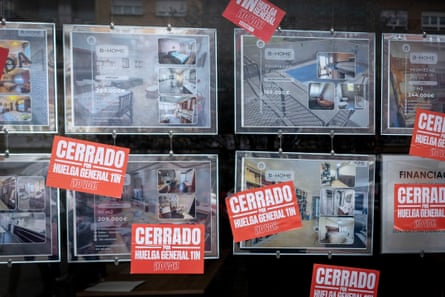 An estate agents’ office in Móstoles, Madrid, covered with stickers calling on people to join the general strike. Photograph: Angel Perez/ZUMA Press Wire/Shutterstock
theguardian.com
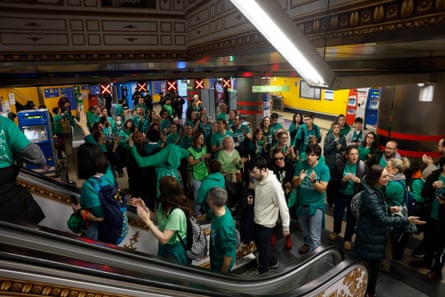 Teachers protest at a metro station in Madrid on Wednesday. Photograph: JJ Guillen/EPA
theguardian.com
Millions of workers downed tools across Spain on Wednesday in the country's first general strike in 14 years, a 24-hour stoppage called by tenants' associations over housing costs. The Confederation of Tenants' Associations said about four million people had taken part by midday. The strike falls weeks before an election in which the far right could gain power.
The trigger was not a wage dispute but rent. Spanish rents rose by 80 percent over the past decade while house prices climbed 63 percent, and a growing share of the housing stock now serves as tourist lets, short-term rentals and speculative assets. Public anger burst into the open in September, when 87-year-old Maricarmen Abascal was evicted from the home she had lived in for more than seven decades; protests and encampments followed across the country.
The stoppage began at midnight, with pickets blocking entry to factories, markets and transport hubs. The workers' unions, which backed the strike only after tenants' associations had called it, reported 90 percent participation in the automotive and port sectors and 82 percent in waste collection — though participation, the unions said, was uneven, strongest in coastal regions such as Catalonia and Andalusia, where the housing cost crisis has been most acute. In Barcelona, protesters burned tyres on roadblocks that shut the AP-7 motorway in both directions and brought public transport to a near-standstill. In Madrid, scuffles broke out between picketers and police near the country's main wholesale market, and thousands of demonstrators halted traffic on the main boulevard. Government officials said more than 40 people had been arrested over minor incidents. Schools and universities worked at minimal capacity, and in Madrid the stoppage merged with a teachers' strike that had begun nearly a month earlier.
Sandra Mora of the Madrid Tenants' Union told broadcaster RNE that workers "who are also renters or who also pay mortgages ... are the ones with the power to halt production and bring the economy to a standstill." In Granada, the local tenants' union vandalised around 300 lockboxes used for short-term rental check-ins in the most touristed areas of the city, leaving the slogan "No to capitalists, no to rent-seekers."
More than 90 marches were scheduled across the country. Two of them, in Cádiz and Huelva, were cancelled — the state meteorological agency had issued 14 alerts for storms with gusts of up to 120 kilometres per hour.