
Czech writer puts Wittgenstein in a Viennese gay sauna
Travelogue reclaims central Europe's queer bathhouse history as nationalists frame homosexuality as western import
Images
 Tomáš Kubík: Torzo Belvedere, 2020. Oil on canvas. Photo: Tomáš Kubík Photograph: Tomáš Kubík
Tomáš Kubík Photograph: Tomáš Kubík
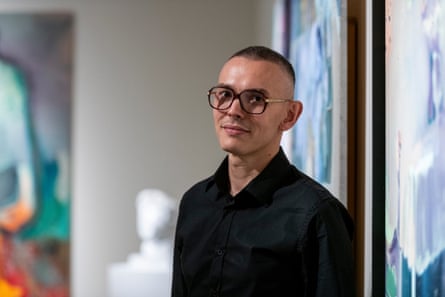 Vratislav Maňák, author of With Wittgenstein in a Gay Sauna. Photograph: Jan Slavík
theguardian.com
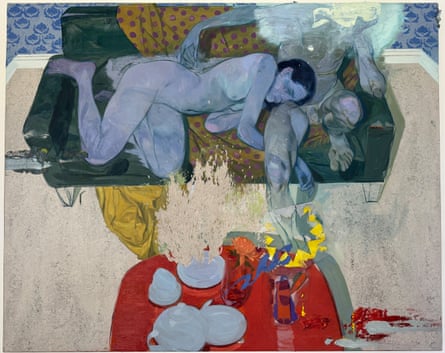 Couple on the Sofa (2019), by Ruprecht von Kaufmann, part of the Andros: The Male Body in Contemporary Central European Art exhibition at DOX in Prague Photograph: Courtesy the artist
theguardian.com
Vratislav Maňák's new book places Ludwig Wittgenstein in a Viennese gay sauna, and the Czech writer means it as an argument. "With Wittgenstein in a Gay Sauna", published in Czech and German to considerable attention, fictionalises the philosopher — born in Vienna, romantically involved with both men and women, and famously silent on the subject — inside the Kaiserbründl Herrensauna, once hailed in newspapers as "the most stylish bathing establishment in the world".
"Although Wittgenstein wanted to solve all the mysteries of philosophy, he overlooked the biggest part of human existence: the body," Maňák told the Guardian. The 38-year-old, who teaches journalism at Charles University in Prague and came out in 2017, frames the book as a travelogue through central Europe's bathhouses, cruising routes and queer subcultures — a region whose governments in Hungary, Czechia and Slovakia are now dominated by far-right populists portraying homosexuality as a decadent western import that arrived with liberal democracy after 1989.
The historical record runs the other way. The word "homosexuality" itself was coined in the 1860s by Karl Maria Kertbeny, a Hungarian translator and progressivist. Historian Anita Kurimay of Bryn Mawr College, author of "Queer Budapest, 1873–1961", notes that Budapest, Vienna and Prague — the Austro-Hungarian capitals — played a central role in developing the very idea of sexual identity, as many of the founding modern sexologists worked there. Wittgenstein, the empire's most influential philosopher, was himself part of that submerged world.
Maňák documents the living residue: Budapest's 16th-century Rudas bath, men-only on weekdays; Prague's cruising trails above the Podolí swimming pool; the commemorative happening gay men staged in the 1970s when the public toilets by the Prague State Opera were demolished, pocketing flame-red tiles from the rubble as souvenirs. Under communism, the sauna was one of the few spaces the state's gaze could not easily penetrate.
"Even though gay saunas are a generational thing, and younger people have their own queer spaces, it shows ways how you can subversively reinterpret urban space and enjoy it — it's a textbook of subtle social resistance," Maňák says.
The nationalist narrative casts queerness as foreign and tradition as native. The empire that invented the word homosexuality, and the philosopher who never dared use it about himself, were both central Europeans.