
XPeng promises passenger flights in China next summer
$300 000 two-seater approved for limited use by Beijing, low-altitude economy is a state project while Europe drafts rules
Images
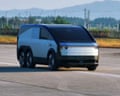 Aridge unveils new modular 'flying car'
theguardian.com
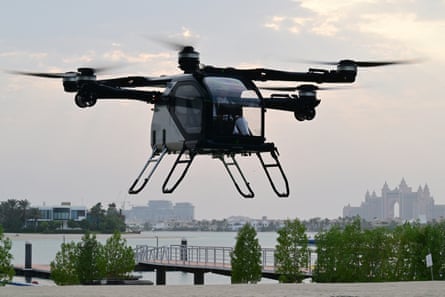 The flying car during a demonstration in Dubai last month. Photograph: Giuseppe Cacace/AFP/Getty Images
theguardian.com
 Tesla's redesigned 'flying car' Roadster performs a ramp-assisted mid-air flip
theguardian.com
XPeng says its two-seat flying vehicle could carry paying passengers in China as early as next summer, with a price tag of $300,000 and a launch customer base of recreational users and emergency services. Chief executive Deli Zhao presented the vehicle at the Web Summit in Lisbon, where he claimed he could teach anyone to fly it in five minutes.
The machine is a helicopter-style drone rather than a car in any meaningful sense — no wheels, a cockpit about the size of a Fiat 500, lifted by six battery-powered propellers, steered with a simple joystick or flown autonomously to a pre-programmed destination. China's civil aviation authorities have approved it for limited use; it will operate only in designated park areas and for emergency services reaching inaccessible locations. Flight range is 30 kilometres, which Zhao says will soon be doubled with higher-density batteries. The price includes a six-wheel van from which the aircraft unfolds — "just like the Transformers."
The vehicle itself is the least interesting part. What matters is the airspace behind it: Beijing's deliberate push to develop what it calls the "low-altitude economy," a state project to open the sky below roughly a kilometre as ordinary economic space. The plan, as Zhao described it, starts with flying cargo, then people, and moves from rural areas to cities. He says his firm is one of about 20 Chinese companies building flying vehicles — an ecosystem that exists because the state decided the sky below a kilometre should be usable. Zhao has signed agreements with the United Arab Emirates and countries in south-east Asia, and says he aims "to enter the European market as soon as possible."
The competitive backdrop is the US–China race in electric vehicles and drones. Elon Musk showed off a Tesla Roadster prototype that performs a ramp-assisted mid-air flip using high-powered gas blasts; Zhao, a trained pilot, dismissed it as "really hopping or jumping and not really flying" and agreed it had the characteristics of a circus act.
Whoever writes the first workable traffic rules for low-altitude flight gets the industry that follows. China's regulator is already approving vehicles for restricted use while Zhao's European ambitions have no regulator to file a plan with. The vehicle flies as high as one kilometre — well below an unpressurised Cessna, and above the ceiling of anyone waiting for a European rulebook.