
Earth gains a temporary second moon, two-metre asteroid 2026 QQ8 completes one and a half loops before gravity ejects it in 2027
Some mini-moons may be fragments of the Moon itself
Images
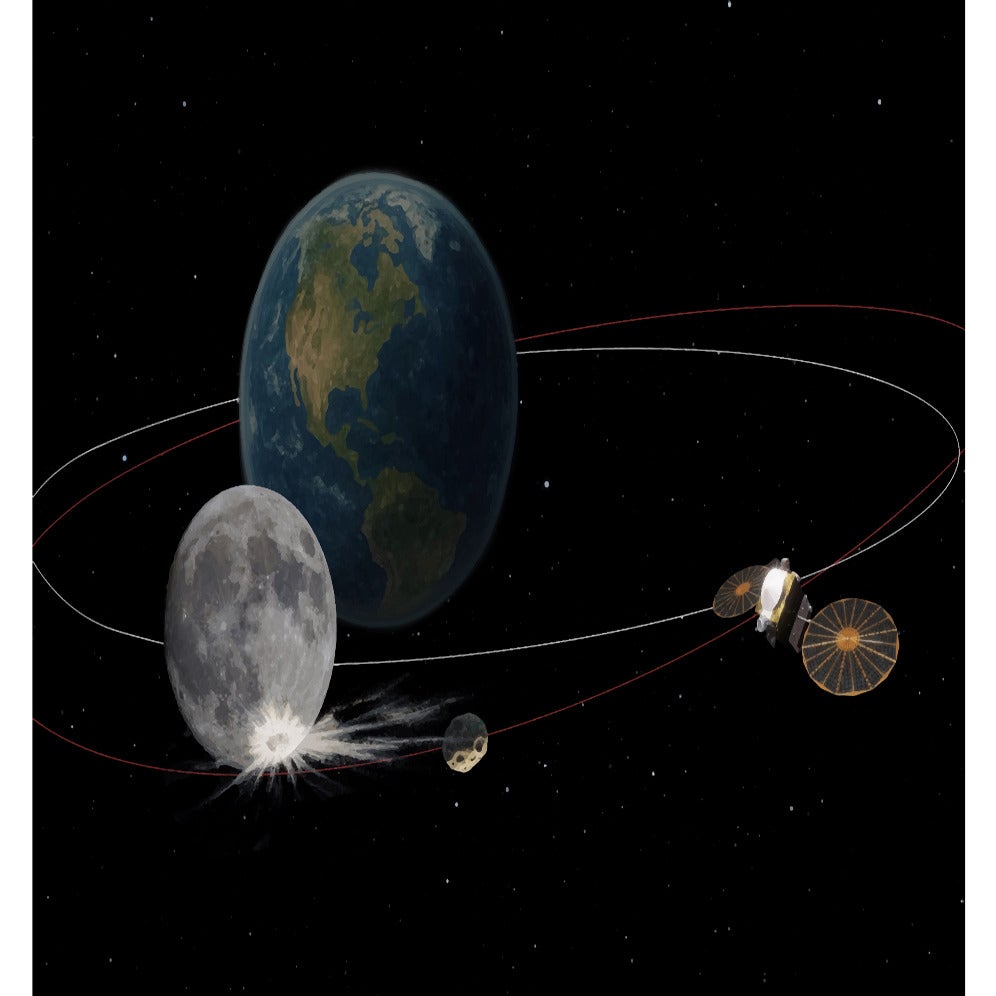 How a mini moon can form following an asteroid impact with the Moon (Cell)
Cell
Earth has a second moon for the next year or so. Asteroid 2026 QQ8, a rock about two metres across, fell into the planet's gravitational grip in April and is now tracing a looping orbit around Earth, the International Astronomical Union's Minor Planet Center has reported. It was first observed in August by Kriztián Sárneczky, a Hungarian astronomer with a record as one of the world's most prolific asteroid hunters.
The capture required no launch pad, no mission control and no budget line: a piece of the solar system parked itself in orbit, unassisted. The asteroid will complete one and a half revolutions around Earth before the combined pull of the Sun and the Moon throws it back out in 2027. Its closest approach during the visit is around 568,000 kilometres, roughly one and a half times the distance between Earth and the Moon, and at two metres wide it poses no danger — a collision course would end in the atmosphere, not on the ground.
Such guests are less unusual than they sound. A study published last year estimated there could be up to six temporary mini-moons circling Earth at any one time, most too small and faint to be noticed. Some may not be visitors at all. Kamoʻoalewa, a 40-metre quasi-satellite discovered in 2016, reflects light in a way that closely matches space-weathered lunar rock, suggesting that impacts on the Moon have scattered substantial fragments into the Earth-Moon system. The line between a moon and a piece of the Moon is thinner than the nomenclature suggests.
2026 QQ8 itself normally orbits the Sun every 359 days and makes a close pass of Earth roughly once a decade, so the planet's gravity has caught a familiar caller. Near-Earth objects typically last in such orbits for one to ten million years, with some persisting up to 150 million — short lives by solar-system standards, and part of the reason the population keeps turning over.
In 2027 the Sun and the Moon will pull the rock loose again, and Earth will go back to the one moon it keeps.