
Landslide kills five at a Gaza displacement camp south of Deir al-Balah, a mother and her two children among the dead as young men broke a boulder with hammers to dig them out
New Israeli berms along a line drawn as temporary now stretch 23 kilometres
Images
 The aftermath of the rain-triggered embankment collapse in Deir al-Balah. Photograph: Ahmed Ibrahim/APAImages/Shutterstock
theguardian.com
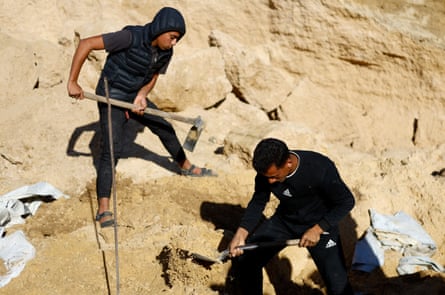 Palestinians remove sand at the site of the deadly sand bank collapse. Photograph: Mahmoud Issa/Reuters
theguardian.com
 Displaced families suffer in Gaza floods as 70,000 tents wrecked – video
theguardian.com
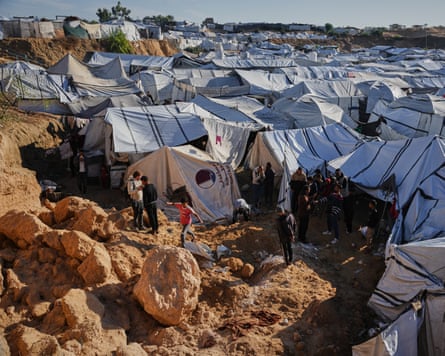 Palestinians inspect tents buried under rocks following the collapse of a large sandstone slab. Photograph: Abdel Kareem Hana/AP
theguardian.com
 Israel Is Rapidly Turning the Yellow Line Into a Permanent Border in Gaza
truthout.org
A sand embankment collapsed onto a camp for displaced families south of Deir al-Balah on Sunday after high winds and heavy rain, killing five people — among them a six-year-old, an eight-year-old and their mother — and burying at least three tents. The children's father had stepped outside after one of them called him to come and eat; he survived and shouted "Save my children!" as young men broke a huge boulder with hammers and dug through the sand with shovels and flashlights. "None of them was moving or making a sound," said Abdul Karim al-Sahhar, 30, who watched from his own damaged shelter. "Even the tent had disappeared completely. There was no trace of it left."
The weekend storms flooded some 70,000 tents sheltering tens of thousands of displaced people, the Hamas-run media office in Gaza said, and the United Nations reports more than 26,000 households with damage to shelters or belongings. Most of the strip's 2.3 million people live in tents or the ruins of bombed-out buildings, and a Unicef spokesperson said the collapse "was waiting to happen" in a territory where people "are just trying to find a place wherever." Reconstruction has not begun in the two years since the military assault launched after the October 2023 Hamas attacks: the US-brokered ceasefire reached last year calls for it, but negotiations have stalled over Hamas disarmament and an Israeli withdrawal, and Israel says no reconstruction can happen before Hamas is disarmed. Israeli troops control about two-thirds of the territory, from which residents have been ordered to leave.
While the talks stall, the ground is being rearranged. An Associated Press investigation using satellite imagery from Planet Labs has documented new earthen berms rising since February along the Yellow Line and in places beyond it — the boundary marked with yellow concrete blocks that was drawn to separate Israeli-controlled ground from the rest of Gaza pending further withdrawals under the ceasefire. By July the berms ran more than 23 kilometres, over half the length of Gaza's coastline, near Rafah, across Khan Younis and north toward Gaza City. The UN humanitarian office calculates that access-restricted areas covered 65 percent of the strip by June. A resident whose half-demolished family home stands a few metres from the line described bulldozers at work outside: "The Yellow Line keeps creeping forward, while a new earthen berm rises day by day, obscuring our view of what lies beyond it." Israeli forces continue clearing and demolishing land and homes along the route; Israel justifies the barrier on security grounds and has equipped it with intelligence and technical assets.
The ceasefire was reached last year. The berms have been rising since February.