
Delhi wakes to hazardous smog after Diwali
99 of world's 100 most polluted cities are Indian, court exempts its own lawyers from vehicle ban while farmers burn what they cannot afford to clear
Images
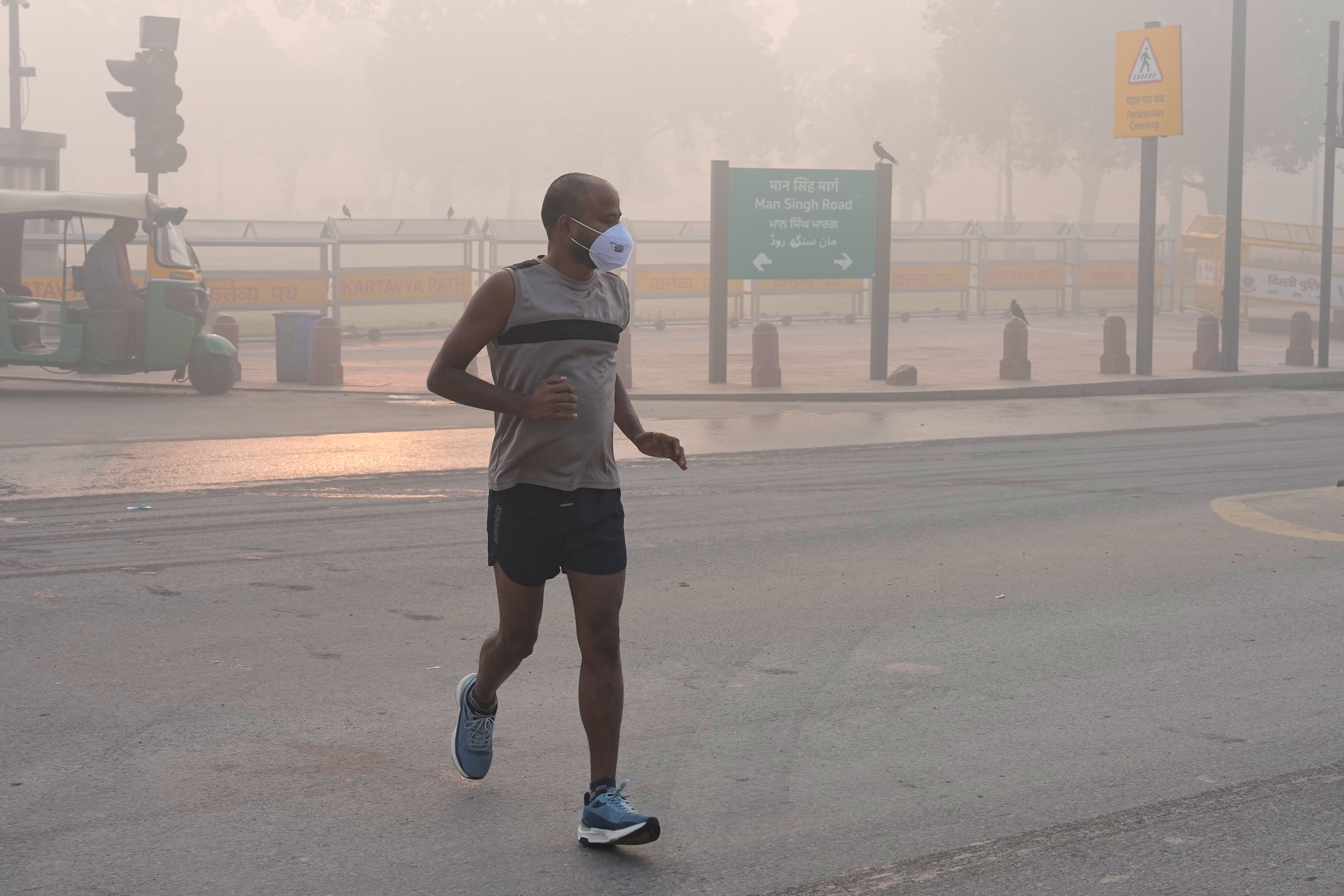 A person wearing a face mask jogs through thick smog after firecrackers lit up the sky overnight during Diwali celebrations in New Delhi, Monday, Nov. 9, 2026 (AP)
independent.co.uk
Delhi woke on Monday to air that private monitors classified as hazardous, one day after Diwali fireworks went off in defiance of court restrictions. Levels of PM 2.5 fine particles reached 879 micrograms per cubic metre at Mandir Marg, according to the Swiss monitor IQAir — nearly 59 times the World Health Organization's recommended daily limit. The tracking firm AQI.in counted 99 of the world's 100 most polluted cities that night, all of them in India.
The ritual is familiar: the Supreme Court in October permitted only certified "green" firecrackers, said to produce fewer emissions, during limited windows on Saturday and Sunday. Scroll found vendors openly selling conventional firecrackers anyway, and residents set them off well past midnight. On Monday the capital's own average air quality index stood at 368, "very poor" by the Central Pollution Control Board's scale, with fifteen of the city's 59 stations above 400 — the level at which authorities stop construction and bar diesel generators. Schools around Delhi have been ordered online; office workers have been urged to stay home.
The fireworks land on top of a seasonal trap. Farmers in Punjab and Haryana burn rice stubble after the harvest because clearing fields any other way costs money they don't have, and the smoke drifts toward a metropolitan region of more than 30 million people just as falling temperatures and stagnant winter air stop pollutants from dispersing. A 2024 study in The Lancet Planetary Health linked 3.8 million deaths in India between 2009 and 2019 to air pollution.
The newest wrinkle is administrative. From November 1, non-Delhi vehicles below the Bharat Stage-6 emission norm are barred from the capital until January 31. On Friday the Delhi High Court ruled that lawyers and judicial staff living in the National Capital Region are exempt — on court working days only — after the High Court Bar Association argued that colleagues commuting from Gurugram, Faridabad, Noida and Ghaziabad might miss hearings. The same bench system that imposes the environmental rules now sorts its own members out of them, while ordinary drivers remain barred. The petitioners noted they were not seeking immunity from the Graded Response Action Plan, the incremental ban regime that tightens as the air worsens — and that is lifted again whenever the wind picks up.
Meanwhile the average AQI in Chennai was 208 on Monday morning, in Lucknow 246 — cities a thousand kilometres from the fireworks, breathing the same country.