
Royal Navy launches first autonomous squadron of uncrewed boats
Portsmouth unit of 180 will operate Rattler and Kraken craft under £1.5 billion hybrid navy plan, admiral insists people remain at the heart of it
Images
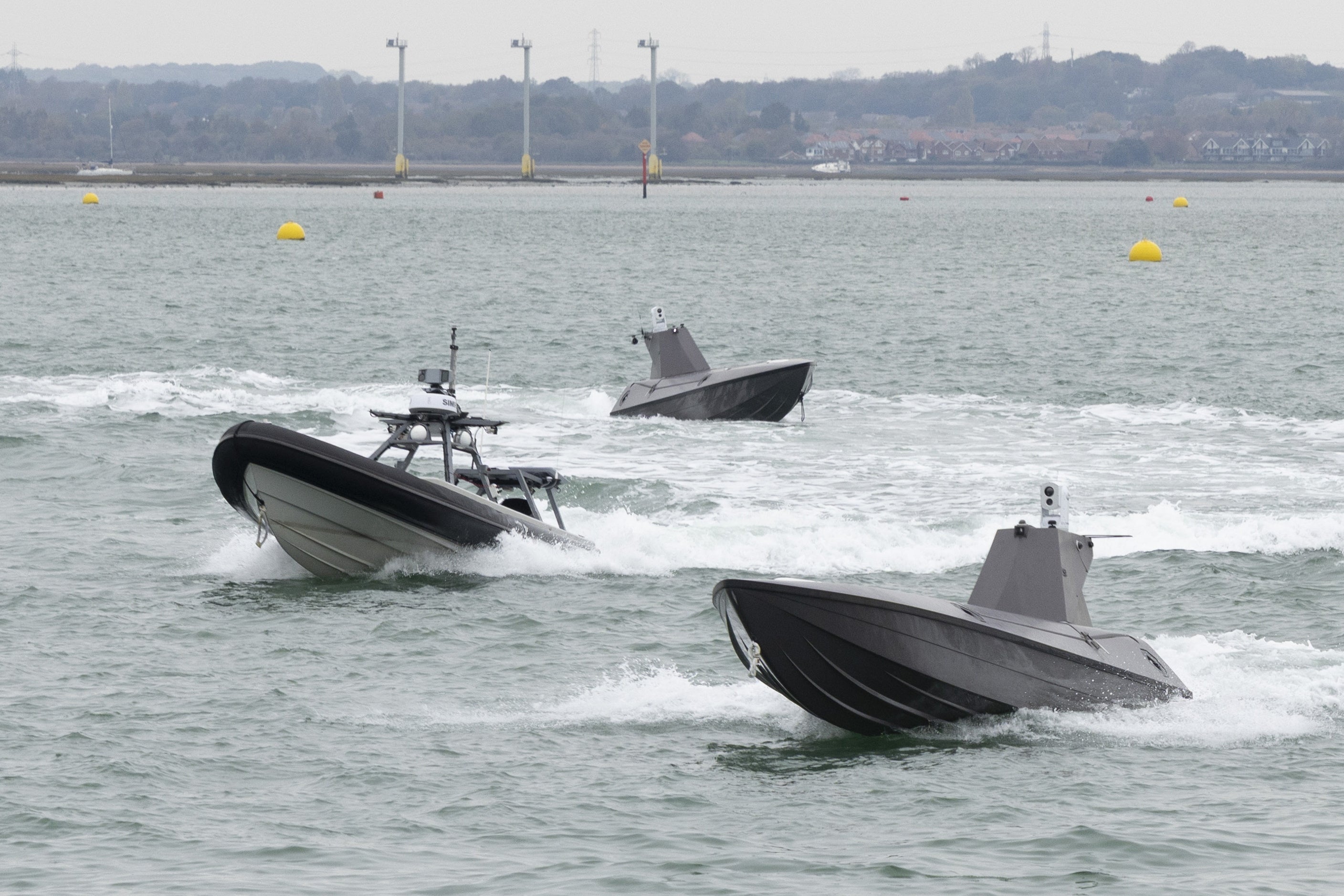 Two Kraken and a Rattler Uncrewed Surface Vessel on display at Portsmouth Naval Base (Ministry of Defence)
Ministry of Defence
 Kraken unmanned surface vessels with HMS Queen Elizabeth in the background at Portsmouth Naval Base (Ministry of Defence)
Ministry of Defence
The Royal Navy formally launched its first autonomous squadron on Thursday, a unit of about 180 personnel based at Portsmouth Naval Base that will operate uncrewed Rattler and Kraken K3 Scout boats on frontline operations. The 1st Autonomous Squadron is the standing core of what the service calls a hybrid navy, a programme earmarked £1.5 billion over four years.
The Rattler training vessels have already escorted warships in Scotland while being remotely piloted from 500 miles away. The Kraken K3 Scout, with a range of 600 miles extendable to 1,100, has been tested off the south coast in force protection, surveillance and reconnaissance roles. Two Krakens and a Rattler went on display at Portsmouth, photographed with HMS Queen Elizabeth in the background — the carrier from which Royal Navy attack drones recently flew for the first time. The hybrid navy concept pairs crewed warships with craft that can be sent forward without anyone aboard.
Fleet Commander Vice-Admiral Steve Moorhouse framed the change in institutional terms. "For generations, the Fleet has been built around ships, submarines, and aircraft, manned by sailors and Royal Marines. From today, an autonomous squadron takes its place alongside them." The seas, he said, are becoming "more contested, more dangerous and harder to operate in," and a hybrid navy means more reach, more striking power and more options — a fleet "more lethal, harder to knock out of the fight and quicker to adapt."
Defence Secretary Wes Streeting tied the squadron to what he called the biggest sustained increase in defence spending since the Cold War and to a threat environment "fundamentally different from that of recent decades." His summary of the new arithmetic: "A major determinant of military power now is who can innovate fastest." The more ready the force is to fight and win, he added, the less likely it is to have to.
Moorhouse's closing assurance was that people will remain at the heart of a fleet whose newest vessels have already been piloted from 500 miles away.