
Museum skeleton buried in Adelaide 113 years after death
German immigrant's bones sold for £10 by anatomy professor who fled murder charges, body donation was not legally possible at the time
Images
 For decades, visitors to the South Australian Museum were greeted by Max the skeleton, the remains of Max Dreyssig, a German immigrant. Photograph: SA Museum
theguardian.com
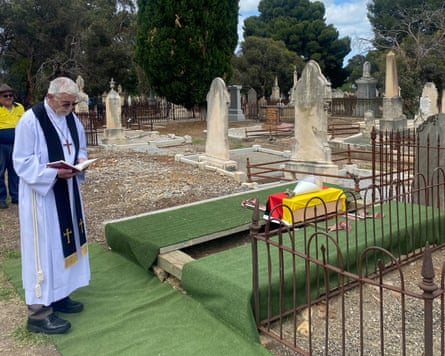 Max Dreyssig’s remains were laid to rest in Adelaide on Saturday. Photograph: Tory Shepherd/The Guardian
theguardian.com
 Max Dreyssig (1850–1913), undated photo. Photograph: South Australian Museum
theguardian.com
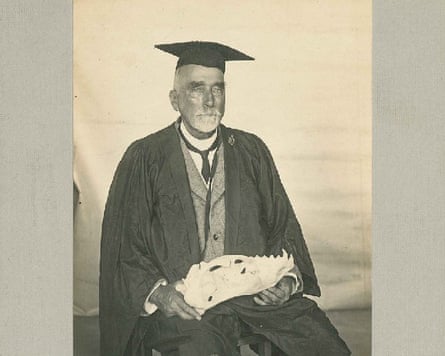 Archibald Watson, an anatomy professor, had been arrested for murder in the South Pacific, before he escaped to Germany where he studied medicine. Photograph: Adelaide University
theguardian.com
A skeleton known to generations of South Australian Museum visitors as Max was buried in Adelaide on Saturday, more than a century after his death. He was Johann David Max Dreyssig, a German immigrant who died of cancer in 1913 at 62 — and who then spent almost 80 years posed in the museum with one leg up on a small chair and a bird skeleton perched on his outstretched hand.
A sign reading 'Human: Homo sapiens' distinguished him from the animal skeletons around him. Earlier photographs show him sitting backwards on the chair, arms draped over its back.
Dreyssig gave his body to his doctor, Prof Archibald Watson — a University of Adelaide anatomy professor who had been arrested for murder and blackbirding, the seizure of Pacific islanders for forced labour, and who slipped bail and left for Germany to study medicine. Watson had Dreyssig reduced to a skeleton and sold him to the museum for £10 in 1920. Anna Russo, the museum's repatriation manager, told the funeral that under the laws of the time it was not possible to donate one's body to one's doctor — and that Watson, the hospital and the museum would all have known it.
Body parts were a particular passion of Watson's, and his methods were not always by the book, according to a 1998 profile by John Healey in the Journal of the Historical Society of South Australia: on one occasion he replaced a torso with an umbrella to fool relatives at a viewing.
Dreyssig in life had been a different kind of exhibit. Awarded the Iron Cross for bravery in the Franco-Prussian war of 1870-71, he moved to Australia in 1885, took children on donkey rides along Brighton beach behind a grey mare named Marie, and donated a dead penguin and a locust to the museum. His obituary recorded that he wore his decoration with great pride at Adelaide's patriotic celebrations.
The burial was arranged by the museum together with Adelaide's German community: a small casket draped with the German flag, last rites read by a Lutheran pastor at West Terrace cemetery, and a wake at the German Club attended by about twenty people.
Watson sold him to the museum for £10 in 1920. The funeral took 113 years to arrange.