
Bantu expansion was a relay of migrations not a single wave
Iron furnaces and DNA redraw millennia of African prehistory, 500 languages from Zulu to Swahili trace back to a spread no state directed
Images
 Credit:
Wikimedia Commons
 Photo of Knowable Magazine
arstechnica.com
Near the village of Mashava, twenty-five miles northwest of the stone ruins of Great Zimbabwe — capital of a kingdom that thrived between 1000 and 1700 AD — clusters of iron-smelting furnaces survive as mounds of rubble. Some were nearly an adult's arm span wide, their clay walls thick enough to hold heat above 2,100 degrees Fahrenheit, and fragments still carry the fingermarks of the people who once smoothed the interiors. Unlike furnaces that needed workers pumping bellows, these drew air in and out through a chimney, with no human labour at all.
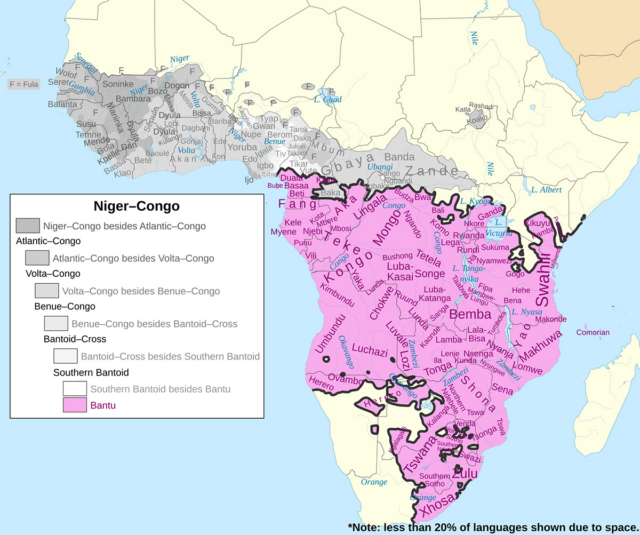
Ezekiel Mtetwa, an archaeometallurgist at Chicago's Field Museum of Natural History, reads their number and size, together with the natural-draft design, as evidence of intensive and technologically sophisticated iron production. The iron became hoes, axes and arrowheads. The people who made it were Bantu speakers, descendants of communities that began expanding from western Africa between 6,000 and 4,000 years ago, carrying farming, livestock, pottery and metalworking into regions long dominated by hunter-gatherers.
That expansion counts among the largest and longest human migrations in history, and researchers are still tracing how it happened. Around 350 million Africans today speak one of roughly 500 Bantu languages, from Zulu in the south to Swahili in the east, and at least as many people — among them many African Americans and Afro-Latinos — carry Bantu ancestry in their DNA. Written records are sparse and research funding thin, so linguists, archaeologists and geneticists have pooled their clues. The first clue was linguistic: when Vasco da Gama rounded the southern tip of Africa in 1497, a Portuguese crew member who had spent time in west-central Africa could reportedly make himself understood to locals in the southeast. Nineteenth-century linguists named the family Bantu, the plural of muntu, 'human being', and reasoned that its greatest diversity in the west marked the point of origin. Archaeology then filled in the route: pottery, village life, metal-making, domesticated animals and western African crops appear across eastern and southern Africa within the last 2,000 years, and northern sites are consistently older than southern ones.
Genetics is now adding its layer, and the textbook version — a single wave of farmers rolling over the continent — keeps dissolving as the data accumulates. What the record shows instead is a relay of movements, with return flows, and with forager lineages that stayed in the gene pool rather than disappearing. Sandra Beleza, a population geneticist at the University of Leicester, puts the scale plainly: the expansion 'completely reshaped the demography in sub-Saharan Africa'.
No ministry directed any of it. There was no programme and no coordinating authority; the expansion ran on households moving gradually, generation after generation, for millennia, and nothing stopped it. In the Horn of Africa as in the south, claims to land and identity still lean on narratives of pure, timeless origins, and every skeleton dug up shows the mixture underneath.
The furnaces at Mashava pulled their air through chimneys, with no one working the bellows. The migration that carried the technology across half a continent ran the same way.