
Crimean champions Sevastopol force Uefa's hand
Promotion to Russian third tier would breach the 2014 ruling on Crimean clubs, federation calls the league amateur while its clubs field professionals
Images
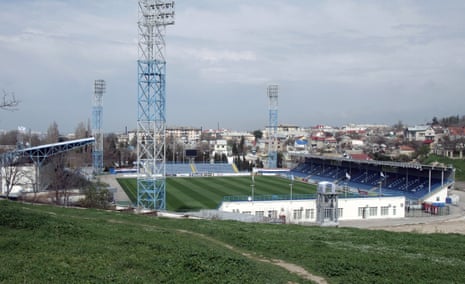 FC Sevastopol’s home in Crimea. The club’s CEO, Valery Chaly, said ‘we should advance to the next stage’ regarding their potential promotion from Football National League (FNL) 2B. Photograph: Vasiliy Batanov/AFP/Getty Images
theguardian.com
 FC Sevastopol’s logo at their home in Crimea. Photograph: Vasiliy Batanov/AFP/Getty Images
theguardian.com
FC Sevastopol, a club based in Crimea, have been declared champions of group one in FNL 2B — in effect Russia's fourth tier — and are in line for promotion to FNL 2A, the professional third division. If the licence is granted, the move would put Uefa's own rules to a direct test, because the governing body ruled in 2014 that Crimean clubs must not compete in competitions run by the Russian Football Union. The RFU remains a member of both Uefa and Fifa.
The RFU's answer to that 2014 ruling has been a workaround: FNL 2B was reclassified as an amateur competition the federation does not operate. Several clubs at that level, contacted by the Guardian, confirmed informally that they are fully professional — and FNL 2A has never denied its clubs are. Sevastopol's CEO, Valery Chaly, told local media last month: "Of course, we plan to submit documents. According to the regulations we should advance to the next stage." No decision on the licence has been made.
The pattern extends beyond Crimea. In 2023 Sevastopol and Rubin Yalta were admitted to FNL 2B; in April 2024 an imitation of Zorya Luhansk — whose home city in Donbas is under Russian occupation — followed. This year an imitation of Shakhtar Donetsk, the Champions League club exiled from its home since 2014, joined as well. Five of the fifteen teams that completed the recent FNL 2B group one season played in or claimed to represent occupied areas. The imitation Shakhtar secured the runners-up spot, and its own promotion path, by winning away at Sevastopol on the season's final day — though unlike Sevastopol it plays its home matches on Russian territory, in Taganrog.
The Ukrainian Association of Football has asked Uefa and Fifa to consider ejecting Russia over the Crimean clubs, calling their admission a "gross violation" of the statutes, and last year asked Uefa to review the imitation clubs' legal positions. Uefa said it would assess the situation.
The pressure arrives as governments quietly loosen other restrictions: Russian diesel has begun flowing again in several markets, and the international bodies that once enforced isolation now face a choice they never asked for. If Sevastopol's ascent is not blocked, fresh calls for the RFU's ejection will follow — and the decision on recognizing annexation will have been taken, in effect, by a licensing committee.