
South Korea sends destroyers toward Hormuz waters
Cheonghae anti-piracy unit extended toward Duqm under strict non-combat limits, country drawing 70 percent of its crude from the Gulf now pays for its own guards
Images
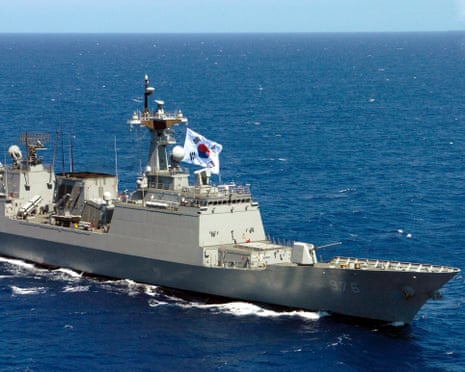 A South Korean naval ship. Seoul wants the Cheonghae unit – which reportedly includes a destroyer, helicopter and rigid-hull inflatable boats – to expand its operations closer to the strait of Hormuz. Photograph: Rebecca J Moat/US navy
theguardian.com
South Korea's defence ministry will expand its Cheonghae anti-piracy unit into waters closer to the Strait of Hormuz, submitting a motion to parliament that extends the unit's area of operation toward the Omani port of Duqm, roughly 650 kilometres from the strait itself. The move comes after months of pressure from Donald Trump, who criticised Seoul for insufficient support during the US war with Iran — pressure Seoul is answering on its own terms.
The fine print matters more than the announcement. The reinforcement is strictly non-combat, according to a defence ministry official who briefed reporters anonymously: operations will remain in open waters south of Oman, and the P-8A maritime patrol aircraft Seoul plans to deploy alongside the unit's 4,400-ton-class destroyer will be prohibited from targeting or monitoring Iranian territory, territorial waters or the interior of the strait. President Lee Jae Myung, whose approval the motion requires, said in September that he would not deploy military assets in a way that could draw the country into conflict. South Korea is not joining America's war; it is buying its own insurance.
The economics make the reasoning plain. South Korea sourced 70 percent of its oil from the Middle East in 2025, most of it shipped through Hormuz, according to the industry ministry. The strait currently hosts three parallel authorities: the US Navy escorts vessels through declared safe lanes, Iran's Revolutionary Guard burns tankers on routes it declares illegal, and Oman's navy recovers survivors while naming no culprit. Iran has begun collecting transit fees from Indian and Chinese vessels while exempting Qatar — a pricing regime replacing the old freedom of navigation.
The deployment also fits a pattern the International Institute for Strategic Studies documented in its recent report on the US-Iran war: Gulf monarchies who spent a trillion dollars on American hardware watched US bases prove vulnerable and are now restructuring their own defences. Allies who once outsourced maritime security to the US Navy are drawing the same conclusion — that the escort service bills the customer either way, and it is safer to hold the contract directly.
Trump scaled back major joint US-South Korean military drills this summer, unsettling Seoul. The Cheonghae unit has been stationed in the Gulf of Aden since 2009, and its Middle East deployment was set to expire at the end of 2026. The extension adds 75 personnel and a maritime patrol aircraft to a force of about 300.
Seoul is sending a destroyer to protect tankers the US Navy said were already protected.