
NASA's Swift telescope burns up after 22 years
30-million-dollar rescue tug tumbled out of control before reaching the gamma-ray hunter, agency now asks the same industry to bid on saving Hubble
Images
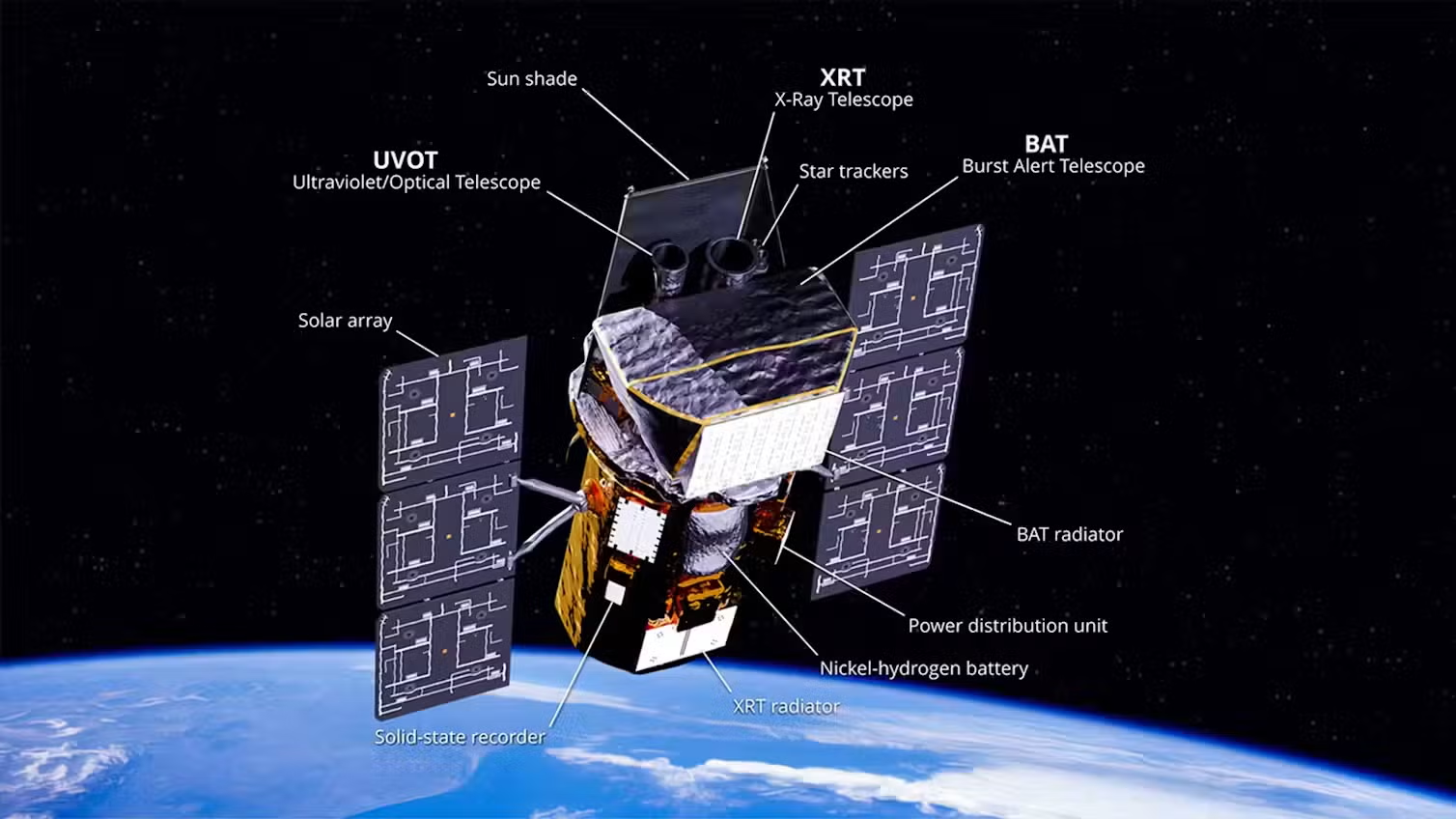 An artist’s concept of the Neil Gehrels Swift Observatory in orbit, with each spacecraft element identified (NASA’s Goddard Space Flight Center Conceptual Image Lab, CC BY)
independent.co.uk
 NASA's Neil Gehrels Swift Observatory satellite (NASA)
NASA
 zerohedge.com
 This undated image released by Katalyst Space Technologies on Friday, Sept. 25, 2026 shows Link, a three-armed robotic spacecraft, while in orbit around Earth. (Katalyst Space Technologies via AP)
Katalyst Space Technologies via AP
 A spacecraft built by space startup Katalyst Space failed to tow NASA's Neil Gehrels Swift Observatory into a higher orbit awaits encapsulation aboard a Northrop Grumman Pegasus XL at NASA's Wallops Flight Facility in Virginia, U.S. June 8, 2026. REUTERS/NASA/Ron Beard
zerohedge.com
NASA's Swift Observatory ended a 22-year mission on Wednesday, reentering the atmosphere as a fireball that the U.S. Space Force tracked to a descent near Indonesia. Launched in 2004 on a Delta 2 rocket for a planned two-year study of exploding stars, the observatory ran eleven times longer than designed, observing more than 2,000 gamma-ray bursts and more than 1,400 supernovas. Its catches included a burst from 7.5 billion light-years away that was visible to the naked eye in 2008; its roughly 12-terabyte archive is cited in about 7,000 papers.
The reentry came less than three months after a $30 million commercial rescue failed. NASA had contracted Katalyst Space to fly LINK, a three-armed robotic vehicle launched in July on the final Pegasus XL rocket, which was to grab a handling fitting on Swift and use electric thrusters to lift both craft to about 370 miles. Weeks after launch, a failed power switch tied to LINK's reaction wheels left the vehicle tumbling; engineers stopped the spin with thrusters, but persistent attitude-control problems forced controllers to abandon proximity operations within about 15 kilometers of Swift. LINK never latched on, never performed a reboost, and has since fallen from orbit itself.
What brought Swift down was the sun. Solar activity in recent years thickened the upper atmosphere and increased drag, decaying the orbit faster than planned. Penn State's operators suspended most science operations from February to late August to conserve altitude. The final observation came on Oct. 20; the spacecraft entered safe mode at 171 miles before a command ended the mission. NASA put the risk of debris harming anyone on the ground at about 1 in 2,100.
"This is not the outcome we were working toward, but it does not change why this mission was worth attempting," NASA Administrator Jared Isaacman said of the failed rescue.
The same problem now points at Hubble, on a longer clock. Deployed in 1990, the telescope has no engine of its own and has been running on a single gyroscope since June 2024. On Oct. 29 NASA asked companies for ways to reboost it, modernize its hardware or carry out a controlled deorbit, in any combination, and says any mission must fly by 2032. Science mission chief Nicky Fox noted that, unlike the rushed attempt with Swift, the agency has time to review its options this round.
NASA expects Hubble to come down between 2033 and 2034.