
Spanish transport minister resigns over Urda train crash
Óscar Puente withdraws from 29 November election lists after 69 killed, union blames degraded systems on liberalised rail network
Images
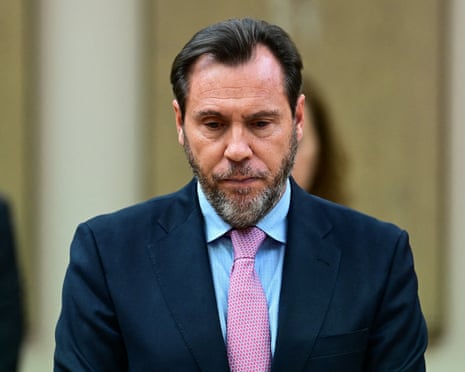 Óscar Puente revealed he was standing down during an address to parliament on Tuesday. Photograph: Juan Barbosa/Reuters
theguardian.com
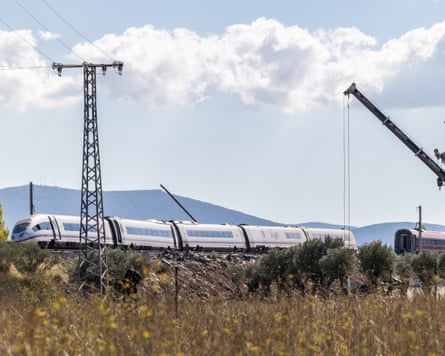 Work on clearing the wreckage of the crash south of Toledo has continued this week. Photograph: Angeles Visdomine/EPA
theguardian.com
Spain's transport minister Óscar Puente resigned on Tuesday, nine days after a rail crash outside the village of Urda killed 69 people, removing himself from parliament's lists ahead of the general election on 29 November.
Puente had repeatedly ruled out resignation since the crash, in which a Renfe train ploughed into the back of a stationary train operated by the private company Iryo, roughly 80 miles south of Madrid. The automatic safety system had failed, halting all trains on a 39-mile stretch of track — but a control centre operator nonetheless authorised the Renfe service to continue at normal speed. Puente announced his departure at the end of a lengthy hearing before lawmakers, having hours earlier presented a safety package he said would let the government "work tirelessly to achieve and regain the public's trust in high-speed rail".
The resignation came under pressure from the rightwing opposition, but also from unions, who criticised Puente for appearing to pin the entire disaster on a single control centre operator. The drivers' union Semaf has called strikes at Renfe for 10 and 12 November, denouncing "degraded systems" and worsening working conditions. Critics point to a longer arc: maintenance investment has not kept pace with passenger growth since the 2021 liberalisation that broke Renfe's decades-long monopoly and let private operators onto the network.
Puente's countermeasures lean heavily on software. He announced a system of automatic alerts for control centres, a second operator to confirm any decision taken while the automatic safety system is down, and an AI agent — a proposal he called unprecedented — to oversee the network and "minimise the possibility of human error". A €30m aid package goes to the families of the dead and the scores injured.
The crash hangs over an election the Socialist prime minister, Pedro Sánchez, is already trailing in the polls. A January collision on the same Madrid–Seville line — Spain's first high-speed route, opened in 1992 — killed 46 people. Spain's high-speed network, the world's second largest, now carries two of the century's worst European rail disasters on consecutive legs of its busiest corridor.