
Trump declares end to US military aid to Israel on election day
Annual four-billion-dollar grants become arms purchases on Netanyahu's request, Israeli officials learn of it from the Fox interview
Images
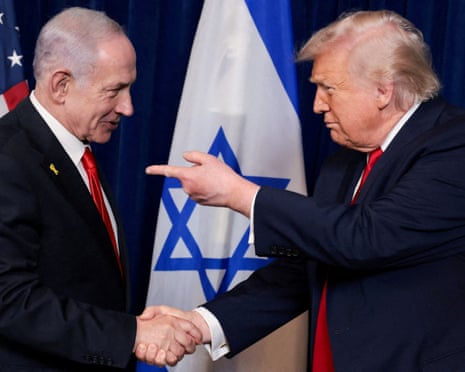 Donald Trump also spoke warmly about the Israeli prime minister Benjamin Netanyahu, left, during an interview with Fox News. Photograph: Jonathan Ernst/Reuters
theguardian.com
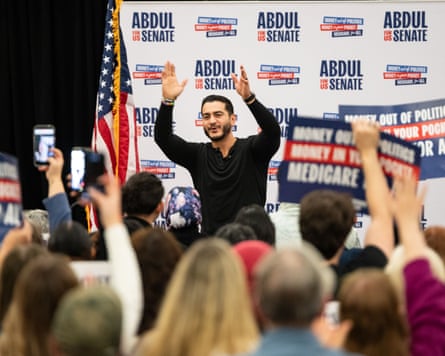 Abdul El-Sayed, pictured campaigning on Monday, would become the US’s first Muslim senator if elected. Photograph: Zach D Roberts/NurPhoto/Shutterstock
Shutterstock
 U.S. President Donald Trump shakes hands with Israeli Prime Minister Benjamin Netanyahu during a press conference at his Mar-a-Lago club on December 29, 2025 in Palm Beach, Florida.
Joe Raedle / Getty Images
Donald Trump announced on Tuesday morning, as midterm voting opened, that the United States will end its annual military aid to Israel at the close of this year. Speaking by phone to Fox News, Trump said the roughly $4bn in annual grants would be replaced by arms sales. "We made a deal months ago that we're stopping, and they're fine with it," he said. "It gets cut off at the end of the year. Because they don't need it."
Trump credited the idea to Benjamin Netanyahu, saying the Israeli prime minister had approached him and that the two had discussed it for a couple of years. Netanyahu had previously proposed tapering the aid off over a decade; Trump's timeline compresses that into weeks. Israeli officials appeared to be taken by surprise by the announcement, and the Israeli opposition — manoeuvring to replace Netanyahu after his bloc fell to 53 Knesset seats last week — reacted with fury rather than celebration. Gadi Eisenkot, Netanyahu's centrist rival, said learning about "a change in the strategic relationship framework through the media" showed how much danger Netanyahu's conduct poses. Yair Golan wrote that a responsible prime minister would have fought to increase American aid, not dismantle it.
Trump was candid about his motive. The $4bn payment, he said, is "too easy" a target: "Why should we suffer the slings from lunatics like [Michigan Senate candidate Abdul] El-Sayed? It's a bad talking point." A Quinnipiac poll in September found 48 percent of Americans believed the US was too supportive of Israel, and El-Sayed, who would be the country's first Muslim senator, had made aid a centrepiece of his race. Trump did not address whether the weapons flowing to Israel on top of the annual grant would stop: Brown University's Costs of War project put US military aid to Israel at a record $21.7bn in the first two years of the Gaza war, a figure the project calls highly conservative, and a taxpayer-funded package of $3bn worth of 2,000-pound bombs is reportedly still pending.
According to Truthout, Netanyahu and his backers have been pushing for a deeper, less publicly scrutinised arrangement — dubbed "Special Relationship 2.0" — centred on an unprecedented US-Israel military integration provision in this year's Pentagon funding bill. The shift matters if it holds: a grant recipient is a client in a welfare system, but a customer who pays can be refused delivery. The Institute for Middle East Understanding Policy Project noted Trump has announced over $20bn in weapons giveaways to Israel since taking office, calling the president "a serial liar". Netanyahu, asked to comment, would have to explain why he requested the end of aid he was previously content to collect.