
Real photo of 14 000 satellite trails over Mount Taranaki dismissed as AI
New Zealand photographer Brendan Larsen stacked 578 exposures and spent 40 hours erasing stars, he filmed his own process in advance because he expected the accusations
Images
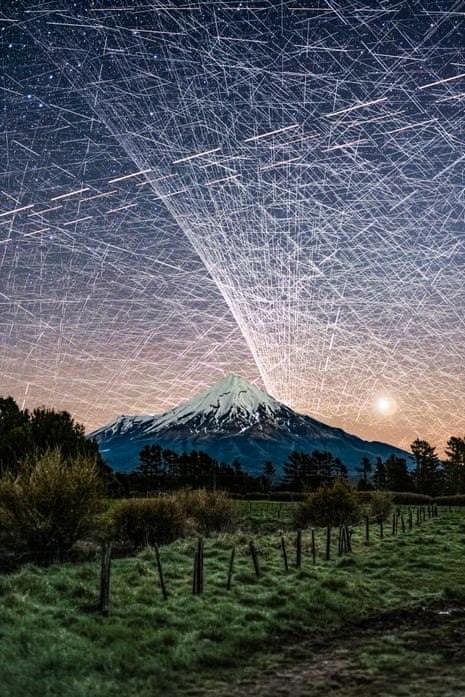 New Zealand astrophotographer Brendan Larsen’s image shows the sky inundated with about 1,400 satellites and 14,000 trails forming a dense crisscrossing pattern above Mount Taranaki. Photograph: Brendan Larsen
theguardian.com
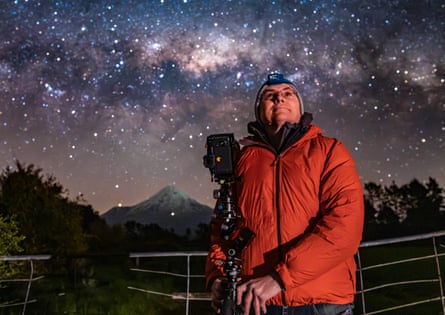 Brendan Larsen, 51, documented his creative process in a video, because he was expecting the accusations that he had used AI. Photograph: Brendan Larsen
theguardian.com
 Timelapse of Photographs taken by Astrophotographer Brendan Larsen vertical Credit: Brendan Larsen
Brendan Larsen
A photograph showing about 1,400 satellites and 14,000 trails cross-hatching the sky above Mount Taranaki has drawn tens of millions of views since its release in mid-October — and, alongside the admiration, thousands of comments insisting it was made with AI. The Guardian reports that the image, by New Zealand astrophotographer Brendan Larsen, is real.
Larsen, 51, spent two hours in September capturing 578 eight-second exposures above the North Island volcano, his camera firing on a loop with two-second gaps between frames. "That was the easy part," he told the Guardian. The rest was roughly 40 hours in Adobe Photoshop, layering the images and painstakingly erasing stars so the satellites would stand out.
The picture gained him 15,000 new followers and about 10,000 comments on his Facebook page alone. Nine in ten, he says, follow the same pattern: "Wow, beautiful photo, but horrifying, terrifying and really concerning about what's happening to the night sky." The rest question whether the photograph is real. Larsen had seen the accusations coming and documented his entire process on video before uploading. AI generation, he says, has become good enough that viewers unfamiliar with a location or with astrophotography can no longer tell real images from fake ones — and his photograph has since been downloaded and recreated by AI, with what he calls obvious flaws.
The satellites are not an artistic effect. About 16,000 working spacecraft now orbit the planet, alongside tens of thousands of defunct satellites, rocket parts and debris from payloads breaking up. Studies have warned that metal particles from launches and reentries could affect atmospheric chemistry and the ozone layer, and the UN has cautioned that growing space activity threatens ground safety, darkness and astronomy. Larsen, who as a child was "absolutely blown away" by the stars over rural New Zealand, has photographed the same sky for six years and says both light pollution and satellite counts have climbed visibly in that time. "It's interesting and fascinating seeing satellites," he says, "but it's also disturbing."
Each of the 578 exposures Larsen stacked held about 25 satellites. The lattice was in the sky before it was in the photograph.