
Dutch weather institute KNMI switches to hyper-local storm warnings
Meteorologists can now draw alert zones along actual weather fronts instead of provincial borders, precision replaces blanket codes the public learns to ignore
Images
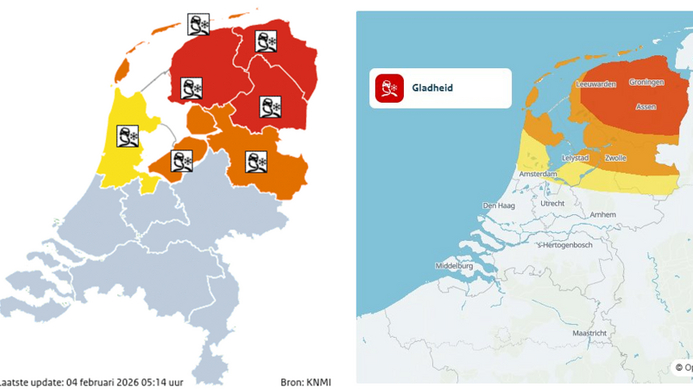 Left: the old provincial-based alert system. Right: the new system. Graphic: KNMI
dutchnews.nl
The Dutch meteorological institute KNMI has replaced its province-wide weather warnings with hyper-local alerts drawn along actual weather fronts, ending a system under which icy roads in northern Friesland triggered a code for the entire province. A law that took effect on May 20 allows the institute to warn smaller areas, and the new method was first used in late August to alert the town of Middelburg to an approaching storm. The KNMI app now lets users zoom in to street-level forecasts, and organisations can download the warning data for their own systems.
The old system drew code red, amber and yellow warnings along provincial boundaries — twelve shapes covering the entire country, plus the Wadden islands. Sea fog on the Zuid-Holland coast put inland towns on alert for conditions they would never see. Remmy van Lisehout, crisis management director at the Amsterdam-Amstelland safety region, said the change lets responders prepare for the specific storm rather than the whole map: an alert for Noord-Holland currently forces Amsterdam to brace for falling trees when the weather is passing through Den Helder, 80 kilometres north. From November, he said, the message will be that it is in Den Helder and not Amsterdam.
The refinement is a quiet admission that warning systems earn trust through precision, not volume. A national alert that fires for conditions most recipients never experience trains people to ignore it — the Dutch equivalent of the boy who cried wolf, coded into an app. The same month KNMI upgraded its system, Ukraine's state-backed air-raid app sent false radiation and chemical warnings to millions of people who went to shelters without a single missile in the sky. Centralised alert architectures fail loudly when they fail, and the Dutch fix — smaller polygons, open data, third parties allowed to build on the warnings — points in the opposite direction: the state supplying the signal and letting others decide what to do with it.