
565 arrested after France's third Saturday of cost-of-living protests
Interior ministry counts 320 000 marchers down from 410 000, Nuñez calls molotov strike on riot officer attempted murder
Images
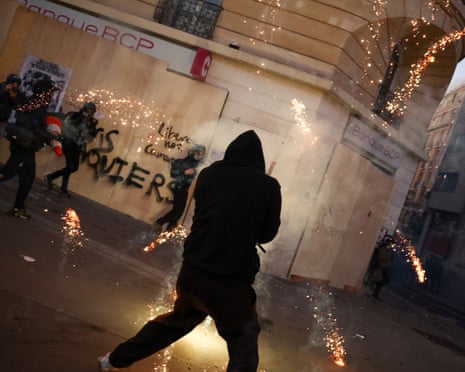 A protester uses a firework during a demonstration organised by labour unions as part of nationwide demonstrations. Photograph: Pedro Nunes/Reuters
theguardian.com
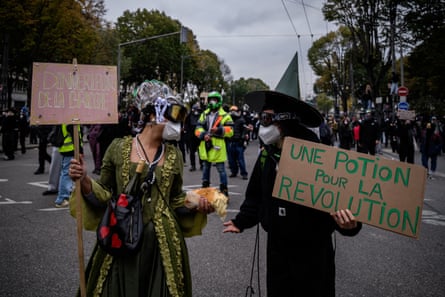 A protester wearing a Marie Antoinette costume holds a placard reading ‘Give them brioche’ flanked by a protester dressed as a wizard holding a placard reading ‘A potion for the revolution’ during a demonstration in Lyon, France on 31 October 2026. Photograph: Jeff Pachoud/AFP/Getty Images
theguardian.com
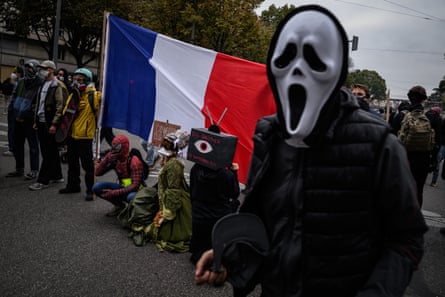 Protesters wearing Halloween costumes pose in front of the French national flag during a demonstration in Lyon, 31 October 2026. Photograph: Jeff Pachoud/AFP/Getty Images
theguardian.com
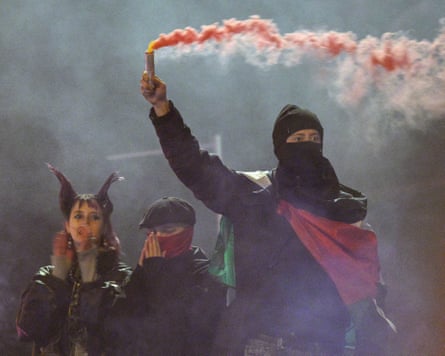 Protesters light smoke flares after a demonstration organised by ‘GenZ regelt!’ (Gen Z has got this!) in Berlin on 31 October 2026. Photograph: Ralf Hirschberger/AFP/Getty Images
theguardian.com
French police arrested 565 people on Saturday as the third consecutive Saturday of cost-of-living protests ended in clashes in Paris, Lyon and Toulouse. The interior ministry counted around 320,000 participants nationwide, down from an estimated 410,000 the previous weekend. In Paris, a riot officer was struck by a molotov cocktail — an incident interior minister Laurent Nuñez described as attempted murder.
The ministry's account of the day splits in two. Some 150 planned demonstrations across the country passed off peacefully, and the Paris march — 70,000 people routed along boulevards on the south-eastern outskirts, from Porte de Bagnolet to Porte de Charenton, avoiding the city centre — set off in Halloween fancy dress beneath a circling helicopter. Across France, 70,000 police and gendarmes were on duty, elite units included: as many officers deployed nationwide as there were marchers in the capital alone.
The violence began when the rallies ended. At the Porte de Charenton, dozens of masked figures dressed in black used hammers to pry up paving stones and hurl them at police, and at least one incendiary device was thrown at security forces. The Paris prefecture counted "a hardcore of several hundred rioters"; officers responded with teargas, stun grenades and baton charges, and four officers and one gendarme were injured in the capital. In Lyon, police fired teargas after protesters threw projectiles. In Toulouse, water cannon were turned on an unauthorised gathering of several thousand people, most of them young.
The marches bring together school students who have spent a month demanding better conditions, trade unions and yellow-vest protesters, united by the cost of living, widening inequality and Emmanuel Macron's government. "We're being run by a group of incompetents who juggle billions while families are struggling with a few cents," said Jérôme Rodrigues, a protester on the Paris march. In Germany, parallel demonstrations ended with police firing teargas as evening fell.
Participation fell by 90,000 in a week while the violence kept to its own timetable, arriving once the demonstrations were ending, as on the previous Saturday. Nuñez had warned in advance that the day looked like "a very high risk", and said police were "fully prepared for those looking for confrontation tonight".
In Lyon, a protester dressed as Marie Antoinette held a placard reading "Give them brioche", flanked by a wizard offering "a potion for the revolution".