
Illegal miners drain Johannesburg animal charity's water tanks
Police call the scale too big to act on as 71 arrests land in a week, 6,100 derelict mines remain unsealed across South Africa
Images
 Cora Bailey, who founded the charity Claw, has encountered illegal miners since 1991. Photograph: James Oatway/The Guardian
theguardian.com
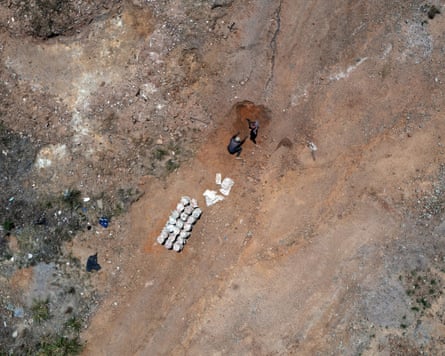 Miners working illegally near the defunct Durban Deep goldmine. Photograph: James Oatway/The Guardian
theguardian.com
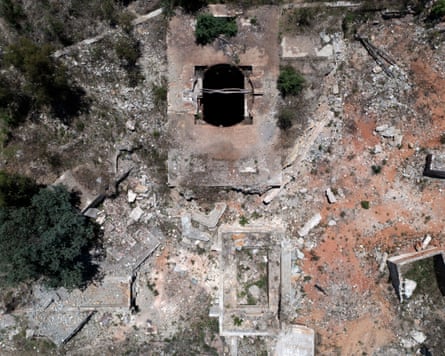 The remains of the Durban Deep goldmine, which is now an illegal mining flashpoint. Photograph: James Oatway/The Guardian
theguardian.com
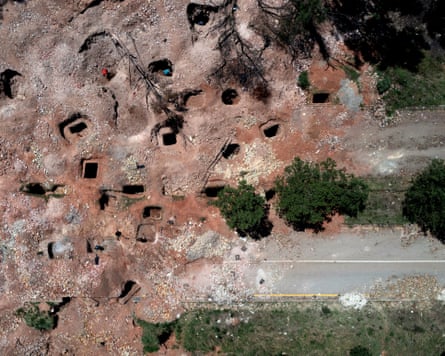 A drone view of a section of Wemmer Pan Road, which was once the main artery linking the city’s central business district to the south-eastern suburbs. Photograph: James Oatway/The Guardian
theguardian.com
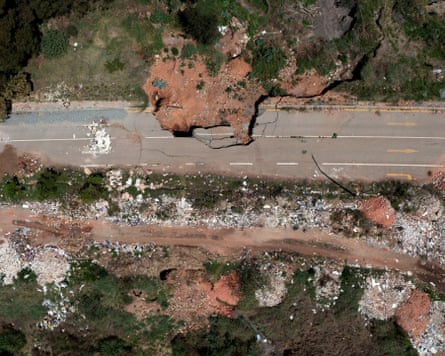 A drone view of a collapsed section of Wemmer Pan Road near Rosettenville in Johannesburg. Rosalind Morris, an anthropology professor at Columbia University, says the biggest culprit of sinkholes in South Africa is formal industrial mining. Photograph: James Oatway/The Guardian
theguardian.com
In mid-October an animal welfare charity on the site of the old Durban Deep gold mine west of Johannesburg closed its gate at midday for the first time ever. Illegal miners camped across the dirt road had drained the two 25,000-litre tanks that water its roughly 100 rescued animals, and about two buckets were left.
The miners are zama zamas — Zulu, roughly, for 'taking a chance' — and researchers put their numbers in the tens of thousands across South Africa. Cora Bailey, who founded the charity, Claw, in the townships around Roodepoort in 1991, says she has never refused anyone water. When she reported the camp, the police told her the mining was too big for them to do anything about. In the week to 19 October, officers arrested 71 suspected zama zamas nationwide.
Johannesburg exists because gold was found on a farm in 1884. South Africa was the world's largest producer for more than a century, until 2007, and a Witwatersrand geology professor estimated in 2009 that the reef beneath the university had yielded more than a third of all the gold ever mined. The city says some 40,000 tonnes remain underground, ever deeper and costlier to recover. Mining companies are required by law to seal their shafts and rehabilitate the land when they close; asked in parliament in 2025, the mining minister, Gwede Mantashe, counted 6,100 derelict and ownerless mines and 1,170 unsafe mine openings.
The gold still leaves the country upstream of the arrests. In 2019 Marcena Hunter, a researcher at the Global Initiative against Transnational Organised Crime, estimated that a tenth of South African production, worth about one billion dollars, was being exported illegally. In 2025, 93 bodies were pulled from a shaft at Stilfontein after officers blocked the delivery of food and water to men underground. The drivers researchers list are the record gold price, poverty, unemployment, corrupt politicians and police taking a share — and mining companies failing to seal the shafts they are obliged to close.
A week after Claw reported the camp opposite its gate, the police response arrived: officers sheared away the grass that had partly hidden the miners. Within days a smaller group was back at the tunnels, drawing water only for drinking.