
First fruit-eating dinosaur identified in North Dakota and Montana
Turkey-sized Infernogallus jamesi crushed berries with a parrot-like beak near the end of the Cretaceous, no living animal combines its three jaw adaptations
Images
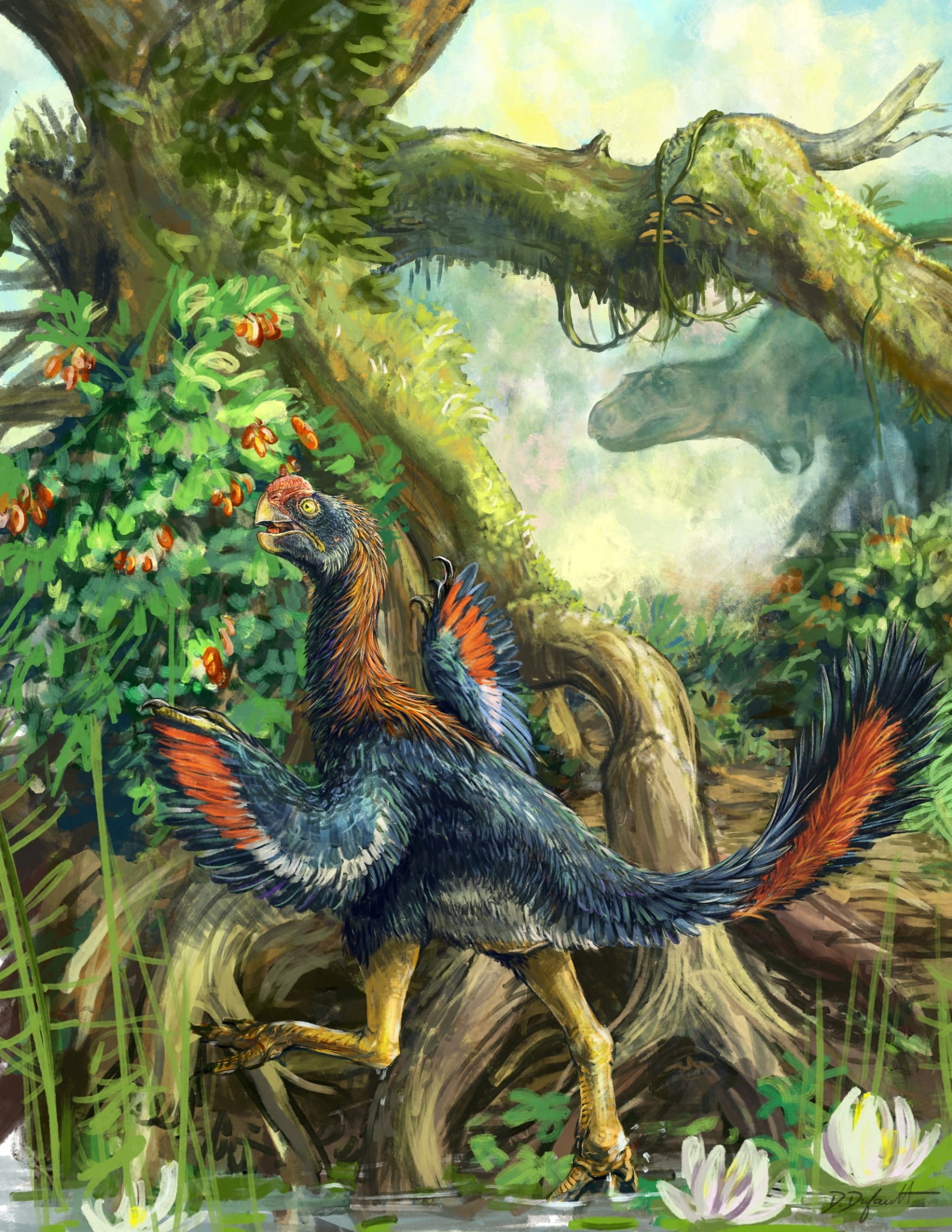 Life reconstruction of the feathered Cretaceous-period dinosaur Infernogallus jamesi eating fruit (Reuters)
Reuters
Researchers have identified the first dinosaur known to have eaten fruit: a toothless, turkey-sized theropod named Infernogallus jamesi, whose parrot-like skull was built to crush soft vegetation. The remains — an almost complete skeleton plus separate palate and jaw bones — come from North Dakota and Montana and are roughly 66 million years old. The description is published in the journal Nature Communications, with Greg Funston of Stony Brook University in New York as lead author.
The name translates as “hell chicken”, a nod to both the animal's bird-like anatomy and the Hell Creek rock formation that produced it — a layer stretching across Montana, the Dakotas and Wyoming that is renowned for major dinosaur finds. Three anatomical features underpin the diet claim: jaw muscles arranged for back-and-forth chewing, a flexible joint that let the lower jaw slide forward, and a beak lined with ridges and grooves for shearing and mashing soft food. Each trait occurs separately in living animals — the fig-eating vulturine parrot, green sea turtles grazing soft sea grass — but according to Funston, no living species has all three.
The finding matters because fruit is the reproductive structure of flowering plants, which first appeared roughly 130 to 140 million years ago and gradually displaced the conifers and ginkgoes that had dominated before them. A dinosaur built around fruit is a dinosaur entangled with that botanical takeover. “It has been proposed before that some groups of dinosaurs ate fruits, but there was never evidence to back it up,” said co-author Thomas Dudgeon of the Royal Ontario Museum in Toronto. The likely menu ran to berries and drupes — the stony-centred category that today includes peaches, cherries, olives and mangoes — on a subtropical coastal floodplain shared with Tyrannosaurus, Triceratops and Ankylosaurus.
Infernogallus measured about five feet long and weighed roughly 25 pounds. No skin or plumage impressions survived, though the researchers suspect it was feathered on the evidence of related species. As a theropod it sat in the group that contains every carnivorous dinosaur, several plant-eating offshoots and the ancestors of modern birds. “This definitely expands the range of lifestyles we thought dinosaurs had,” Funston said, “and it shows how adaptable theropods were.”
Flowering plants had been spreading for roughly 70 million years by the time the first confirmed fruit-eating dinosaur appears in the fossil record — 66 million years ago, near the end of the Cretaceous.