
EU withdraws offer of associate member talks with Canada
Von der Leyen's landmark proposal collapses into an "ever closer association" to be defined by 2027, ambassadors rescued the Commission from its own announcement after Trump called it laughable
Images
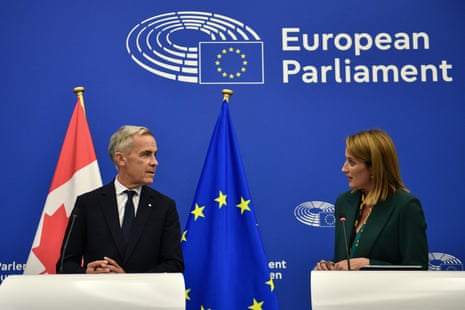 Mark Carney and the European Parliament president, Roberta Metsola, in Strasbourg last month. Photograph: Ahmet Sel/Anadolu/Getty Images
theguardian.com
The European Union has withdrawn its offer to open "associate member" talks with Canada, days before an EU-Canada summit opens in Montreal. The draft joint statement now promises only that the two sides will "work to define by the 2027 EU-Canada summit the concept of an ever closer association of Canada to the EU, short of full membership itself" — a formulation stripped of the term that made the original offer a landmark.
Commission President Ursula von der Leyen had floated "associate membership" for Canada in her state-of-the-union address last month, an offer to a non-EU state without precedent since Croatia joined the bloc in 2013. It was read as a reply to Canadian prime minister Mark Carney's Davos call in January for "middle powers" to band together, and it surprised more than Brussels' partners. Diplomats noted "associate status" has no definition anywhere in EU treaties, and no settled answer to whether Canada would sit in the European Council or legislative bodies without a vote. The concept had previously been mooted and rejected for Ukraine.
At a Monday meeting, EU ambassadors raised concerns and sought, in one diplomat's words, a path to rescinding the offer without embarrassing von der Leyen. "Nobody was consulted about associate membership apart from her closest staff," the diplomat said. Italy suggested keeping the phrase but leaving the definition to member states; Germany pushed further, arguing "associate membership" should be reserved as an interim step for candidate countries such as Ukraine or Montenegro — statuses with treaty grounding that a bilateral Canada deal would lack.
One external pressure was explicit. Donald Trump called the EU proposal "laughable" and warned that if he interpreted it as a "hostile act", the US might stop trading with Europe "on many things". A previous draft of the summit statement had contained at least two references to Canada as an "associate member"; those are gone. Carney, for his part, told reporters the summit was merely "the launch of formal negotiations that will take place another year" — a sentence that describes both the process and the pace.
The remaining draft language invokes the pair's "shared goals of prosperity, economic security and strategic autonomy" — a phrase that survived precisely because it commits no one to anything. The bloc that could not define the status in its own treaties has now defined it twice: once by announcement, once by withdrawal.