
Death toll reaches 68 in Spanish high-speed train crash
Union says one dispatcher managed 22 trains at Atocha, government leaks driver audio to friendly outlets while strike goes ahead
Images
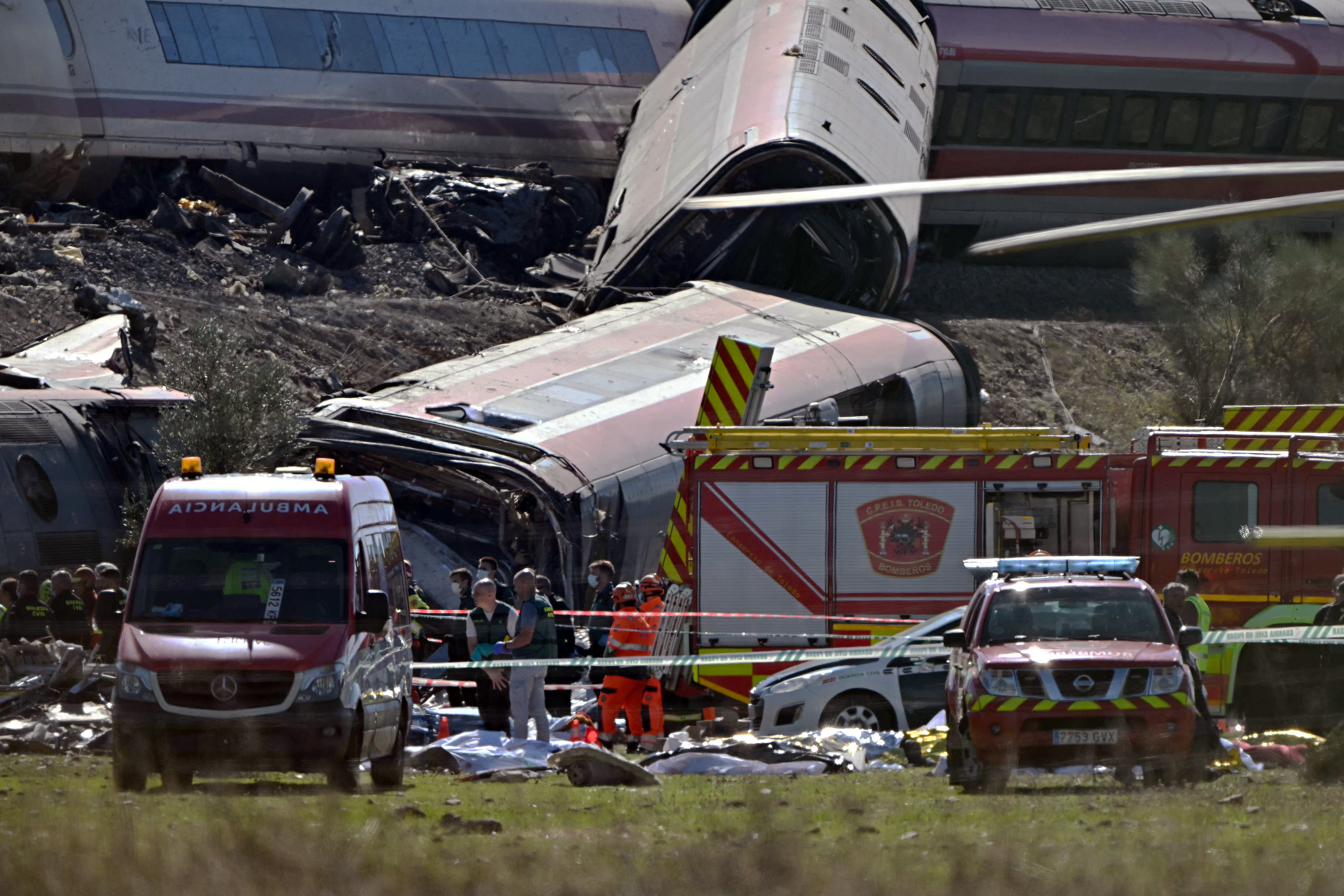 Emergency services working at the site of the collision (AFP/Getty)
AFP/Getty
 The Spanish prime minister has promised the government will seek answers (AFP/Getty)
AFP/Getty
 Emergency services attend to the victims at the scene of a collision | Cordon Press
libertaddigital.com
 libertaddigital.com
 libertaddigital.com
The death toll in Wednesday's high-speed collision near Toledo has reached 68, and Spain's Guardia Civil has begun interviewing every member of staff who was on duty at the Atocha control centre in Madrid when the order was given for one of the trains to resume its journey. Transport Minister Óscar Puente called that order "inexplicable" and attributed the crash to human error — a computer failure had halted at least six train services in the area just before nine in the morning, and a decision was then taken to let a high-speed train continue, leading directly to the collision between Mora and Orgaz. A total of 544 people were travelling on the two trains.
The government's account is already under challenge from the railway union. Rafael Escudero, secretary general of the Sindicato Ferroviario, says that on the morning of the crash the Centro de Regulación de Circulación at Atocha was staffed by a single dispatcher managing 22 trains on a network segment that mandates two personnel. He describes chronic understaffing the administration has ignored, and says the incident occurred on a day when a meeting had been scheduled to address precisely the inability to cover shifts. The union also claims the LZB geolocalization and speed-control system has been failing frequently and for a long time — not just on the day of the accident — and that Adif had repeatedly warned about signalling failures on the Urda segment where the collision took place. The modern RTEMES system, Escudero says, keeps being postponed in favour of temporary fixes.
Meanwhile the government has been managing the narrative. Audio recordings of the conversations between drivers and the Adif control centre were released — not through the courts, but via leaks to El País, Cadena SER and elDiario.es. At 8:36, according to the recordings, the driver of train 2080 was told: disconnect and reconnect the LZB and resume movement at normal speed under the BSL. El País reports the Iryo driver received the same instruction to resume normal speed; seven minutes later that driver reported being unable to restart the train on the LZB system. Five minutes before the collision, no one had warned the AVE that the Iryo train needed to brake. The company's own version, via EFE sources, holds that the Iryo driver began conversations to resume movement and was struck ten minutes later, before actually restarting.
The drivers' union Semaf has confirmed a nationwide strike will go ahead on Thursday, called before the crash but now framed as being "in defence of railway safety". Sánchez posted praise for the emergency services and "the extraordinary coordination between institutions". More than 500 rescue personnel worked into the night, including 422 Guardia Civil members with three helicopters, drones and search dogs; foreign nationals are among the dead.
The official story is that one man in a control room made an inexplicable choice. The union's counter-story is that one man was left in a control room meant for two, on a line whose safety systems had been failing for years, while the replacement system stayed on the drawing board.