
Finnish and Norwegian leaders call Putin directly on Ukraine
Stubb and Støre bypass Washington with frank phone talks ahead of Abu Dhabi trilateral, Nordic capitals price direct signalling below waiting on US intermediaries
Images
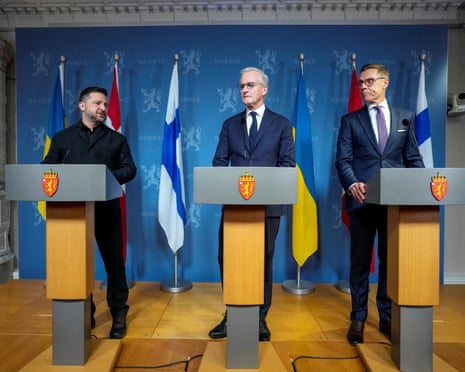 Volodymyr Zelenskyy, Norwegian prime minister Jonas Gahr Støre and Finnish president Alexander Stubb at a press conference in Oslo, Norway, last week. Photograph: Cornelius Poppe/Reuters
theguardian.com
 Kommenterar Stubb samtalet med Putin? Se hans tal i Nordiska rådet
yle.fi
The presidents of Finland and Norway picked up the phone to Vladimir Putin on Tuesday, in a call Alexander Stubb described as "frank and substantive" about ending the war in Ukraine. Stubb and Norwegian Prime Minister Jonas Gahr Støre spoke as leaders of their own countries, they stressed — not on behalf of Europe.
The call was a follow-up to an Oslo meeting involving Volodymyr Zelenskyy, and it came ahead of trilateral Russia–Ukraine–US talks expected in Abu Dhabi in early November. Stubb told reporters that ending the war requires direct discussions with Russia; Støre emphasised de-escalation and what he called the war's enormous human and material costs. Both countries share an interest, they said, in stability in the Baltic Sea region and the High North.
The significance lies less in what was said than in who dialled. Finland carries 1,300 kilometres of Russian border and a decade of NATO membership doctrine built around never negotiating bilaterally with Moscow. That a Finnish president now treats a direct line to the Kremlin as an ordinary tool of statecraft marks a shift that no alliance communiqué announced. Stubb followed the Putin call with a conversation with Zelenskyy, then delivered a speech on Nordic security at the Nordic Council meeting in Helsinki — the public framing for a channel that had until now run through Washington.
The timing is hard to miss. The same week, Zelenskyy publicly complained that Patriot interceptor deliveries sit in a queue awaiting the signature of the US defence secretary, and that global interceptor stockpiles are strained after the American conflict with Iran. Nordic capitals can read that ledger as well as anyone: if the United States meters its own allies' air defence by bureaucratic throughput, then direct signalling to Moscow may price out waiting for an American intermediary. Stubb and Støre were careful to disclaim any European mandate — a hedge that simultaneously acknowledges the channel exists and leaves room for Washington to object to it.
The open question is whether Stockholm joins the channel or is left outside it. Sweden shares the Baltic Sea geography and the same exposure, but appears so far absent from the call log. The Nordic pair, by acting without an alliance seal, have established that such calls can happen — and that they do not require one.
Stubb's speech in Helsinki was delayed by technical problems with the broadcast.