
Serbia's Student List takes outright majority and opens government talks
Leaderless movement holds 141 of 250 seats after Vučić concedes, prime minister candidate still unnamed
Images
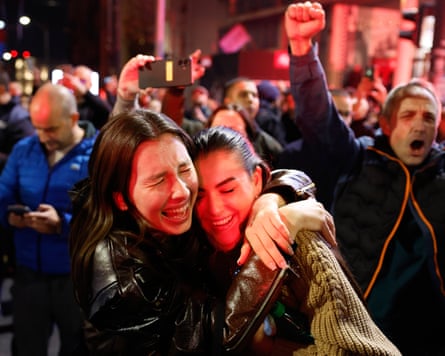
 Young Serbians celebrate outside the national assembly building in Belgrade on Monday after Student List won the country’s parliamentary elections. Photograph: Armin Durgut/AP
theguardian.com
 Drone footage shows crowds in Belgrade celebrating defeat of Aleksandar Vučić – video
theguardian.com
 Student List supporters in Belgrade react to the rightwing Serbian Progressive party conceding defeat on Sunday. Photograph: Marko Drobnjaković/AP
theguardian.com
 Student List supporters celebrate as Aleksandar Vučić concedes defeat in the parliamentary election in Belgrade, 26 October 2026. Photograph: Uros Arsic/Reuters
theguardian.com
 Aleksandar Matković
theguardian.com
Serbia's Student List has won an outright parliamentary majority and is preparing coalition talks to form a government — despite having no leader, no hierarchy, and no one yet publicly designated as prime minister. With all ballot samples counted, the Belgrade-based Centre for Free Elections and Democracy projects the movement on 53 percent of the vote, giving it 141 of 250 seats. Aleksandar Vučić's Serbian Progressive Party takes 39 percent and 103 seats, ending 14 years of increasingly authoritarian rule that the outgoing president conceded late on Sunday.
The movement grew out of two years of protests triggered by the collapse of a canopy at Novi Sad railway station that killed 16 people — a disaster that came to symbolise the state of public infrastructure under a regime that had extended its control over the media, the judiciary and state appointments. Its candidates included academics, actors and farmers alongside students; the list was headed by Ilija Srdanović, a cardiologist, with former central bank governor Dejan Šoškić among its prominent figures. On election night, supporters danced and cried outside the national assembly in Belgrade, while in Novi Sad a flag bearing the image of convicted war criminal Vojislav Šešelj — hanging since the 1990s — was torn down.
The platform is built on fighting corruption and restoring the rule of law: an independent police unit accountable to prosecutors rather than the interior ministry, a purge of officers linked to organised crime, a ban on party loyalists appointed to state-owned companies, and new independent bodies to scrutinise major infrastructure spending. The last point is pointed. Vučić's name became intertwined with multinationals such as Rio Tinto, which sought to extract Serbia's lithium, and Aleksandar Matković — a lecturer at the blockaded Belgrade faculties and one of the movement's candidates — reports receiving death threats after publishing a critical scientific paper on the lithium question. From the students' standpoint, conventional party leaders were easy to corrupt when confronted with the financial power of international projects; collective decision-making was their answer.
That answer now meets the machinery of the state. Public institutions remain staffed with civil servants loyal to the outgoing regime, and the Guardian notes the parallel with Hungary, where Péter Magyar's Tisza party ended Viktor Orbán's 16 years in power this spring and then faced the same problem. Candidate Ana Mirković, a psychologist and educationist, described the result not as gaining power but as taking on "a historic debt to our own people and to our own children", with "the social and psychological detoxification" of the country as the first priority.
Who will actually sit in the prime minister's office remains an open question — the movement has no hierarchy to produce an answer.