
Spinosaurus spent most of its life underwater, AI analysis of 11,000 fossil measurements backs the submarine reading against the wading heron
Same method pulls ancient marine reptiles back onto land
Images
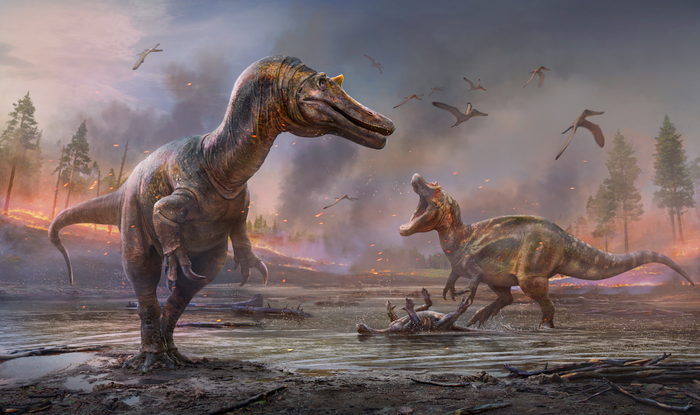 Artists impressions of the Spinosaurids (Anthony Hutchings via Eurekalert)
Anthony Hutchings via Eurekalert
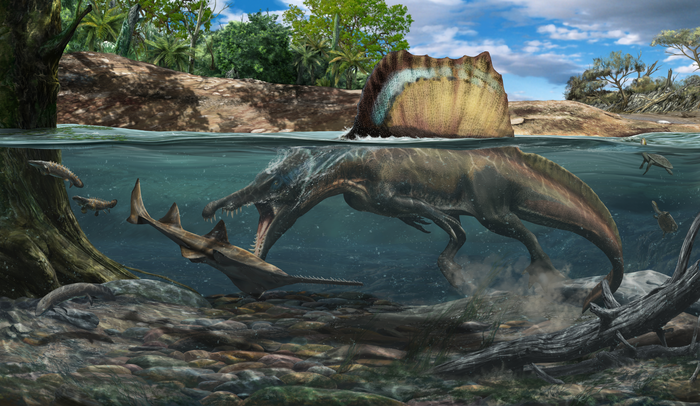 Spinosaurus hunting (Davide Bonadonna via Eurekalert)
Davide Bonadonna via Eurekalert
The sail-backed predator featured in the 2001 film Jurassic Park III spent the vast majority of its life underwater, according to a new study published in Current Biology. Researchers trained an artificial intelligence model on more than 11,000 measurements, photographs and CT X-ray scans drawn from hundreds of fossil and modern specimens housed at the Yale Peabody Museum and institutions worldwide.
The finding lands in a long-running argument over what the animal actually was. Earlier work cast Spinosaurus as a pursuit predator that chased prey underwater in the manner of seals and penguins; rival papers restored it as a heron, walking shorelines and searching for food in shallow water. The new model learned what skeletal proportions say about lifestyle in living species, then applied the rulebook to extinct ones — and it can also predict tissue adaptations, including the swimming structures that almost never survive fossilisation. "We confidently recovered highly aquatic habits for Spinosaurus," Dr Caleb Gordon, one of the study's authors, said of the result: an animal that spent most of its time submerged.
The analysis does not push everything into the water, however. Mesosaurs, marine reptiles that lived between 290 and 274 million years ago in what are now South Africa and eastern South America, have been treated as fully aquatic ever since scientists established that they gave birth to live young — the standard marker of a life spent at sea. The model returns them to land for considerable stretches all the same.
Spinosaurus itself lived in what is now northern Africa between 113 and 94 million years ago. Its remains have now licensed a swimming monster, a wading bird and, once again, a submarine — each reconstruction built from the same bones. Whether the next paper keeps it submerged is a question the field has already answered differently before.
Mesosaurs gave birth to live young, the long-standing proof of a life spent entirely in water. The new model sends them ashore regardless.