
Japan builds robot dogs to hold the line against record bear incursions
Akita prototype Hacchan will bark at wildlife in emptied countryside, 238 people injured in a year as forests reclaim villages
Images
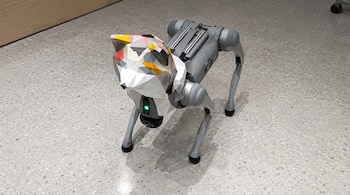 Robot cuadrúpedo de color gris con una máscara de polígonos de colores en el frente, situado sobre el suelo de una habitación
infobae.com
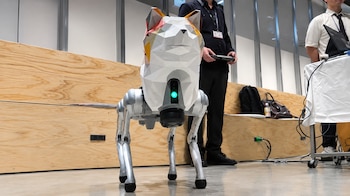 Robot cuadrúpedo con una cubierta poligonal blanca y naranja frente a un operador que sostiene un mando en una sala con bancos de madera
infobae.com
 Los perros robots japoneses recopilarán datos para ajustar sus rutas frente a los osos (EFE/EPA/FRANCK ROBICHON)
infobae.com
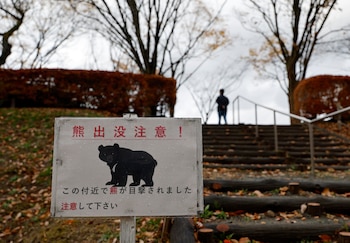
 Entre abril de 2025 y marzo de 2026, el país registró 238 personas atacadas por estos animales y 13 muertes, mientras los reportes subieron un 150% (EFE/ Luong Thai Linh)
infobae.com
Researchers at the Provincial University of Akita have built a robot dog to stand between Japan's towns and the bears that increasingly wander into them. The prototype, named Hacchan, is designed to patrol the transition zones between forest and settlement, detect approaching animals with cameras, sensors and infrared, and scare them off with recorded barks and growls. Field tests are planned before the end of the year. Whether it works outside a laboratory is, for now, an open question — the device has never autonomously identified, pursued or frightened a real bear.
The timing explains the urgency. According to Japan's Ministry of the Environment, 238 people were injured or otherwise affected in 216 bear encounters between April 2025 and March 2026, including 13 deaths — record figures since official counting began. Asiatic black bear sightings nearly tripled year on year, from 20,513 to 50,776. Akita Prefecture alone logged 13,592 reports, followed by Iwate with 9,739 and Miyagi with 3,559.
The bears are not invading so much as filling a vacuum. Decades of rural depopulation have emptied the villages that once formed the buffer between forest and suburb; the hunters and farmers who once kept that line have moved to the cities, and the animals have followed the space. Hacchan's designers lean into that history deliberately — the robot is styled on the Akita Inu, the dog traditionally used by the matagi hunters of northern Honshu, and the plan calls for packs of robots that share a bear's location with nearby units and respond together, mimicking a hunting party. The prototype was presented on October 13 at a university exhibition following a contest that drew 41 proposals on preventing human-bear encounters, of which six were selected.
The plan is non-lethal by design: no injuries to animals, just sound and movement, plus a log of bear appearances and movements that can be used to adjust patrol routes. But the multi-robot strategy has no field data behind it either, and the whole apparatus is, at bottom, a machine substitute for a relationship that used to be maintained by people living where the robots will now be sent.
Hacchan may well work. What is certain is that the bears arrived long before the robots.