
Gunmen kill seven and wound 40 at church funeral in Jordan
Attack on Greek Orthodox church in Karak prompts three days of national mourning, government names no attackers as prime minister promises harshest penalties for terrorist ideology
Images
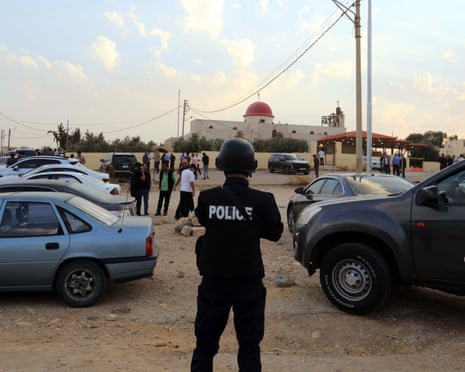 A police officer stands guard outside the church where a shooting attack occurred during a funeral in Karak, Jordan, on 23 October. Photograph: Xinhua/Shutterstock
theguardian.com
Gunmen opened fire during a funeral at a Greek Orthodox church in the southern Jordanian city of Karak on Friday, killing seven people and wounding 40, according to authorities. Health minister Ibrahim al-Budour said two of the wounded are in critical condition. King Abdullah II declared three days of national mourning and wrote on X that Jordan "will confront the terrorist act that targeted Karak with the harshest penalties."
Footage broadcast on Jordanian state television showed two men holding pistols approaching the church and firing, followed by a third carrying a semiautomatic rifle; all three then ran toward the building. A mourner, Dorgham Halasa, said heavy gunfire erupted fifteen minutes after the funeral began, and that others inside reported seeing four attackers — a figure the Associated Press could not independently verify. The government statement described "unknown assailants" and said investigations were under way at full speed. It did not say whether any gunman had been captured or killed.
Prime minister Jafar Hassan, speaking at a security meeting in Karak the same evening, attributed the attack to "terrorist ideology and blind extremism" and promised legal measures against those who seek to introduce extremism. The legislative response was announced before any attacker had been identified.
Karak, about 180km south of Amman, is home to a minority Christian population and has seen coordinated violence before: in 2016, gunmen ambushed police in a series of attacks there, including at a Crusader castle popular with tourists, killing ten people, seven of them officers, before security forces killed the attackers after a long standoff.
Condolences arrived from across the region — Lebanon, Syria, Egypt and Oman — and from Ahmed al-Tayeb, the grand imam of Cairo's Al-Azhar, the Sunni Muslim world's foremost religious institution, who called the shooting a "heinous terrorist attack." Iraq's foreign minister Fuad Hussein telephoned his Jordanian counterpart to affirm his country's solidarity, and UN Secretary-General António Guterres, through a spokesperson, called an attack on a funeral "especially heinous" and demanded that those responsible be found and held to account.
Security services have released no details about the attackers. The penalties were announced within hours.