
Chinese women reject Beijing's birth campaign as population shrinks for fourth straight year
Generation born under one-child policy now told to have three children, state spent 35 years preventing the births it now demands
Images
 Chinese women seek to break out of traditional roles
english.elpais.com
China has recorded the lowest birth rate in its history, and its population has fallen for four consecutive years. Yet in a Beijing alleyway, the women the state wants to have children are explaining why they will not. "I don't want children," said Qin, 28, outside a concert hall in the Wudaoying hutong, beer in hand. "Much less so if I'm being pressured into it."
The one-child policy, devised in the late 1970s, ran for more than three and a half decades and was enforced through abortions, forced sterilizations and abandonments. It also sharpened a traditional preference for sons; Qin's father wanted a boy and made that clear throughout her childhood. The rules became a two-child policy in 2016, and since 2021 the authorities have promoted three children. In 2023, Xi Jinping urged the All-China Women's Federation to "guide" women to "play a unique role in promoting traditional virtues and establishing good family customs."
Qin and her friend Shao, 27, are among the first Chinese women with university degrees and their own incomes — advantages their grandmothers never had — and they are putting them to use. "At university we're not taught to develop critical thinking, nor is feminism discussed. We have to educate ourselves," Shao told El País. Most women interviewed for the report declined to give their full names. Feminism is not banned outright, but independent activism around women's rights operates in an increasingly narrow space, and the Cyberspace Administration has spent the past two years acting against what the authorities call "extreme feminism."
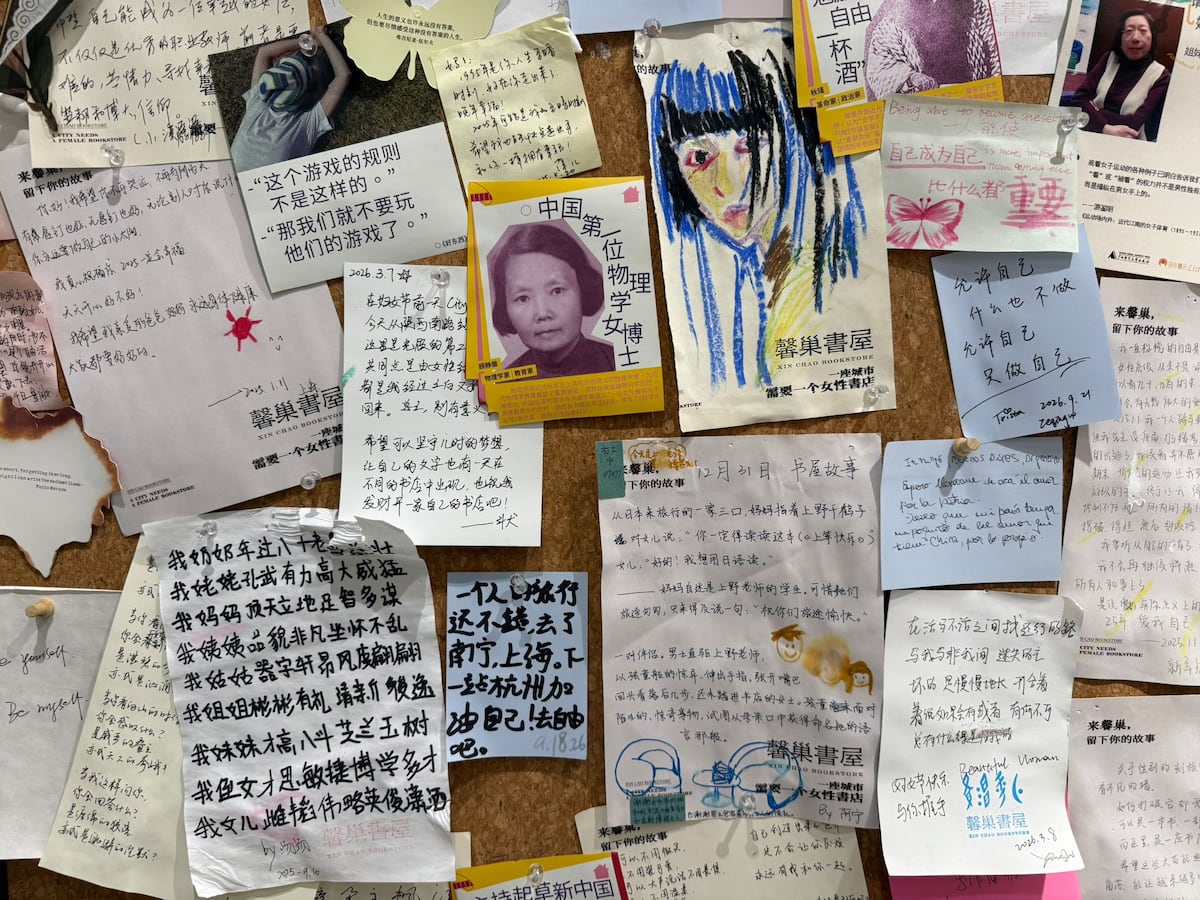
Communities have sprung up in the big cities where women share experiences and question what society expects of them. Lilith, 34, owns Half the Sky, a women's bookstore in a residential district of east Beijing, named for the Maoist slogan that women hold up half the sky. She runs a women-only reading club, film screenings and courses, and asks participants to stay off political topics. She also serves a cocktail called the Wu Zetian, after the only woman ever to rule China as emperor. Had she been a man, she says, her family would have backed her move to the capital to start a business. "We always have to prove ourselves much more."
Qin was born under the one-child policy, when the state's interest ran the other way. "Any policy related to women," she said, "is never for our benefit but for the national interest."