
Steve McQueen stages Bowie and Nina Simone duet that never happened
Dark Guggenheim Bilbao room pairs their 1966 and 1976 recordings of Wild is the Wind, curator says no knowledge of the singers is required
Images
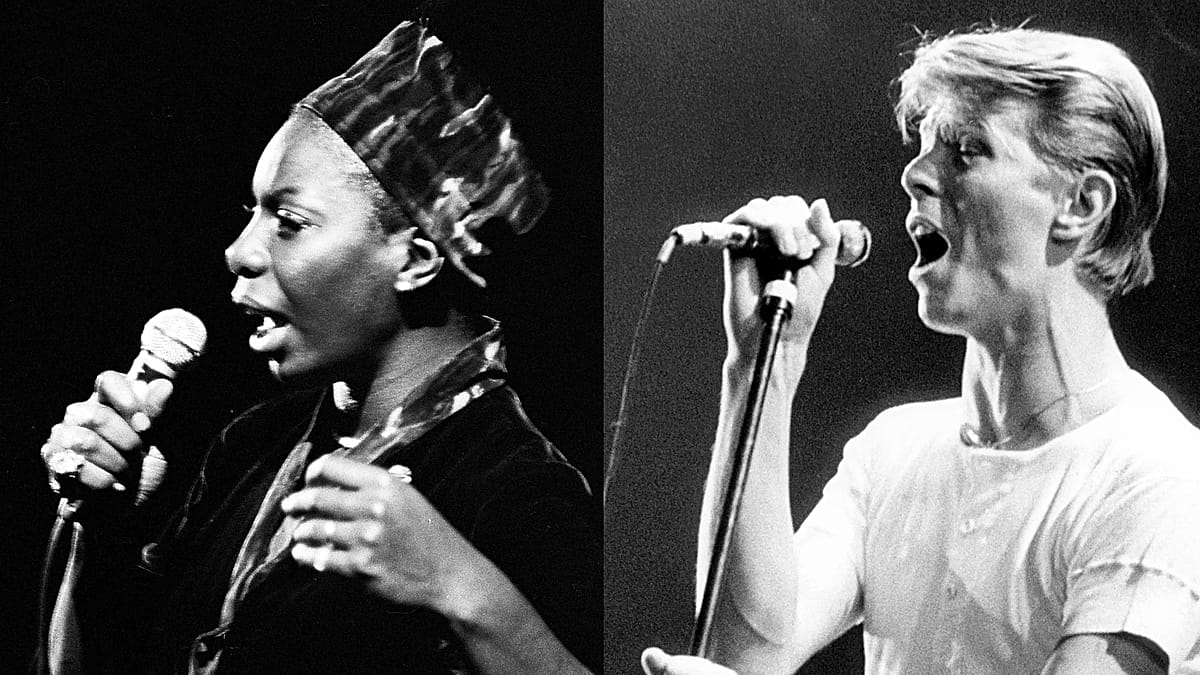 Steve McQueen brings together David Bowie and Nina Simone in Bilbao
euronews.com
In a darkened room at the Guggenheim Bilbao, with a few spots of light and a fluffy carpet underfoot, Nina Simone sings a cappella in one corner. From another corner David Bowie answers, with the same words of the same song. The duet at the centre of Steve McQueen's exhibition '66–76–26' never took place: the two never recorded together.
The exhibition is a sound sculpture with no image, and its title supplies the coordinates: the years in which Simone and Bowie each recorded 'Wild is the Wind', and the year of the show. The song was written by Dmitri Tiomkin and Ned Washington for the 1957 film of the same name, and first sung by Johnny Mathis. Simone recorded it in 1966 and, in McQueen's telling, 'took that song and took it to another stratosphere'. Bowie recorded it a decade later as a tribute to her version — an homage that begins with a certain imitation of her voice, McQueen says, and then goes somewhere of its own. Both sing in A major. 'By putting those two things together, these two stones, it makes fire,' the filmmaker says.
The singers did meet, once, in 1975: Simone's daughter wanted to go to a Bowie concert and dragged her mother along, and they met Bowie afterwards. A year later he recorded the song she had made her own. Both recordings appeared in moments of political tension — civil rights and Vietnam behind one, Watergate behind the other — and the work invites reflection on the conditions through which the song has travelled. McQueen, an Oscar-winning filmmaker, first heard it 30 years ago.
Curator Lekha Hileman frames the show in deliberately undemanding terms: no familiarity with the song, the singers or the artist is required. 'This is an exhibition that's very experiential,' she says. 'It's about feeling, it's about being present. It's about slowing down and just receiving something. So in that way, it's very universal.'
In the dark, McQueen's account of what happens is that the viewer becomes the other voice in the work. He also knows, he says, for sure, that Simone and Bowie would be happy with the duet.