
Alberta rejects separation by 76 to 23 percent
Danielle Smith added the question after a court quashed a separatist petition, ballot asked only whether to begin the process toward a binding referendum
Images
 globalnews.ca
 Click to play video: 'Alberta referendum: Elections official questioned about delays in opening voting locations'
globalnews.ca
 Click to play video: 'Alberta referendum: Seperatist leader Jeffrey Rath says province will never be independent as long as ‘avowed federalist’ Danielle Smith is UCP leader'
globalnews.ca
 Click to play video: 'History lesson: How Canada’s 1968 election led to the Alberta referendum'
globalnews.ca
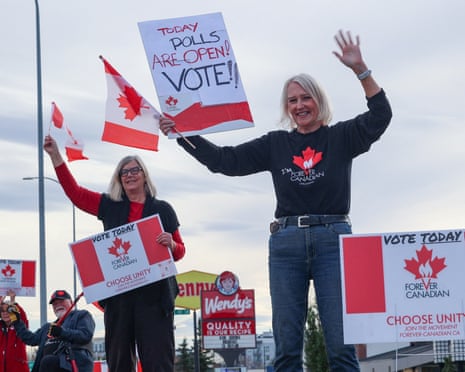 Supporters of the pro-Canada group Forever Canadian wave flags and hold signs to urge people to vote in Alberta's non-binding independence referendum. Photograph: Ahmed Zakot/Reuters
theguardian.com
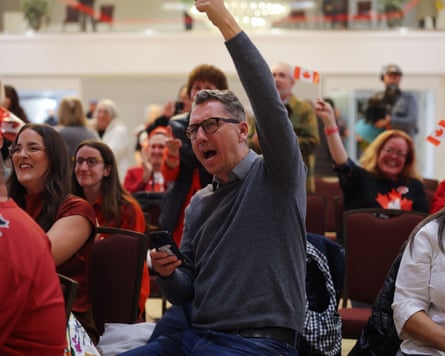 Cheer as results begin to display at a pro-Canada watch party in Edmonton. Photograph: Canadian Press/Shutterstock
theguardian.com
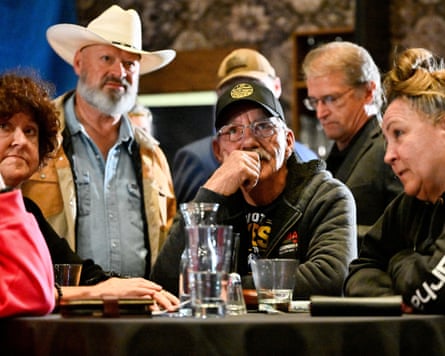 Supporters of a group that promotes independence from Canada. Photograph: Jennifer Gauthier/Reuters
theguardian.com
Alberta voters rejected separation from Canada on Monday night, with roughly 76 percent choosing to remain against 23 percent backing the start of a legal process toward independence. By midnight, with about a third of ballots counted, 883,641 favoured remaining and 278,062 favoured proceeding — enough for CBC to project the result early Tuesday.
The question reached the ballot by an unusual route. The referendum was announced in February with nine questions on immigration and constitutional powers; Premier Danielle Smith added the separation question in May, after a Court of King's Bench judge quashed a separatist petition on the grounds that the government had a duty to consult First Nations before signatures could be gathered. Smith argued that because the referendum would not "directly trigger separation," the ruling did not apply. Nor did the ballot ask about independence itself: voters were choosing between remaining in Canada and beginning the legal process toward a future binding referendum — a vote on whether to hold a vote.
The outcome was never in doubt. Polling since the beginning of 2026 had consistently shown about 70 percent of Albertans wanted to remain, and an Ipsos survey in January found that while three in ten supported independence, only half of those stayed committed once confronted with the costs and consequences. Smith's leadership of the United Conservative party rests in large part on separatists who ousted her predecessor Jason Kenney. She said she would vote to remain while declining to require party members to do the same, and has spent recent months trying to placate both separatists and federalists in the party. The referendum has instead become a liability, with the party's popular support tumbling in recent months.
The grievances underneath are decades old: farmers' resentment of the Canadian Wheat Board's monopoly over crop prices, Pierre Trudeau's National Energy Program, which decimated jobs and investment in the province's oil and gas sector in the 1980s, and more recently Justin Trudeau's energy policies and public health restrictions during the COVID-19 pandemic. Federal politicians crossed the province in the final days. Mark Carney, who grew up in Edmonton, warned that "a vote against Canada is a dangerous bluff that will lead to years of deep uncertainty and lost opportunities for Albertans and Canadians." Conservative leader Pierre Poilievre, whose own parliamentary seat is in Alberta, told supporters that Albertans were not quitters: "Canada is more than a government. It is a people, a flag, a land, a history and a promise."
Turnout was heavy: roughly 43 percent of eligible voters, about 1.3 million people, cast ballots before Monday through advance polls and mail, up from some 810,000 by those methods in the 2023 provincial election, with 519,082 mail-in ballots received — a tenfold increase. Elections Alberta must count every vote by hand within 48 hours, and delays at roughly 100 of 1,400 polling stations pushed results back more than two hours; full counting could take days.
Separatist leader Jeffrey Rath said the province will never be independent as long as "avowed federalist" Danielle Smith leads the party the separatists installed.