
Iran attacks at least 15 container ships in Hormuz strait
Mines and drones strike vessels near Omani coast as Tehran reasserts control of the chokepoint, fishers ordered to leave floating cargo to the state
Images
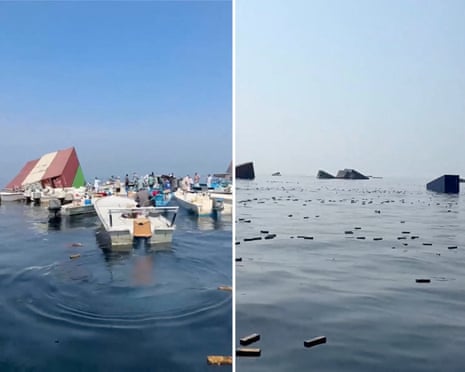 Screengrabs from a social media video show containers and debris floating in the sea after the GFS Pride sank off the coast of Oman last week. Composite: Reuters
theguardian.com
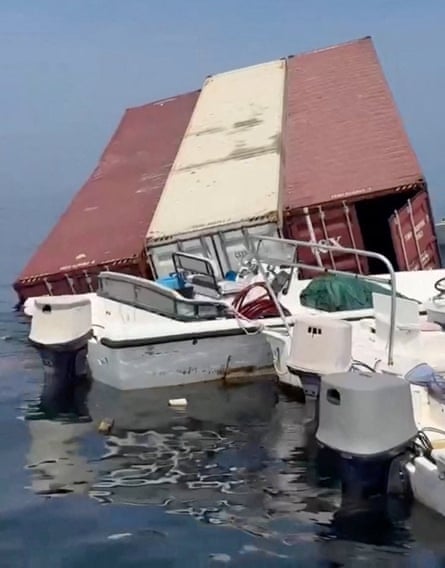 A container from the Singapore-flagged GFS Pride floats alongside small motorboats after the ship sank off the coast of Oman on 14 October. Photograph: Social media/Reuters
theguardian.com
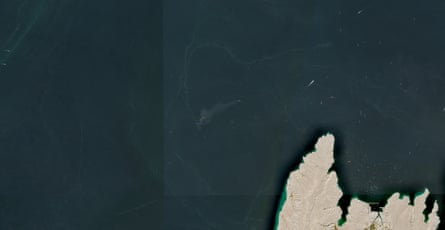 A satellite image shows containers and items floating in the water after the Singapore-flagged GFS Pride sank off the coast of Oman on 14 October. Photograph: European Union/Copernicus Sentinel-2/Reuters
theguardian.com
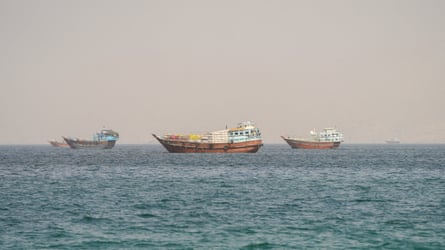 Vessels in the strait of Hormuz, as seen from Musandam, Oman. Iran has offered to open the strait in six days in return for sanctions relief. Photograph: Reuters
theguardian.com
Iran has attacked at least 15 container ships in the Strait of Hormuz over the past ten days, according to the Guardian, with some vessels hit by drones and others by mines. On Sunday a ship was struck by a rocket-propelled grenade launched from a small boat some 75 miles north-east of the Saudi port of Jubail. Brent crude traded close to $108 a barrel on Monday morning.
The attacks concentrate on the route close to the Omani coast, which Iran regards as unauthorised. The UK Maritime Trade Operations Centre recorded 12 vessels attacked in the seven days to Friday 16 October. The Revolutionary Guard Corps says it has the right to strike any ship that traverses the strait without its permission or with transponders off — and the Guardian reports that the campaign appears to have helped resolidify Tehran's disputed control over the waterway.
Last Wednesday a ship travelling from Karachi to Fujairah sank after hitting a mine, Iranian state TV reported. All 21 crew members were evacuated without injury, but dozens of its 2,500 containers were left floating in the sea. Rumours spread on social media that iPhones and other luxury goods were aboard, fuelled by AI-generated fake photos, prompting fishers to row out and investigate. One fisher told an Iranian reporter that Arab boatmen arrived first, cutting containers open with stonecutters and taking whatever was inside.
The state moved quickly to reassert ownership of the salvage. Iranian officials ordered local fishers not to pillage the sea for luxury items, saying the goods are the property of the state. Col Javad Mokhtar Rezaei of Iran's cyber police told Tasnim that salt water corrodes electronics anyway — boards, batteries, displays — while a spokesperson for the Iranian mobile phone association noted it would be unusual for valuable devices to travel by sea at all.
The shipping picture is deteriorating faster than the diplomatic one. Two oil tankers were hit on Saturday, one a supertanker carrying two million barrels of oil, with a third struck late on Sunday; Fars published video appearing to show a tanker burning, which could not be independently verified. UKMTO counted 254 transits of the strait in the week to 14 October — roughly 70 percent below pre-conflict levels.
A marine researcher at Anna University in Chennai warned that toxic debris and oil spills now threaten the region's habitats, and that the noise of the strikes may itself have disturbed marine life. Tehran's cyber police, meanwhile, is busy explaining why the floating cargo is not worth taking — after its navy spent a week putting it there.