
Chinese rocket stage lands in Minnesota cornfield
Zhuque-2E deorbited over the American Midwest the same day it launched ten Qianfan satellites, sheriff works to notify the owner while the liability convention has never paid a claim
Images
 Credit:
Wang Jiangbo/Xinhua via Getty Images
 Photo of Stephen Clark
arstechnica.com
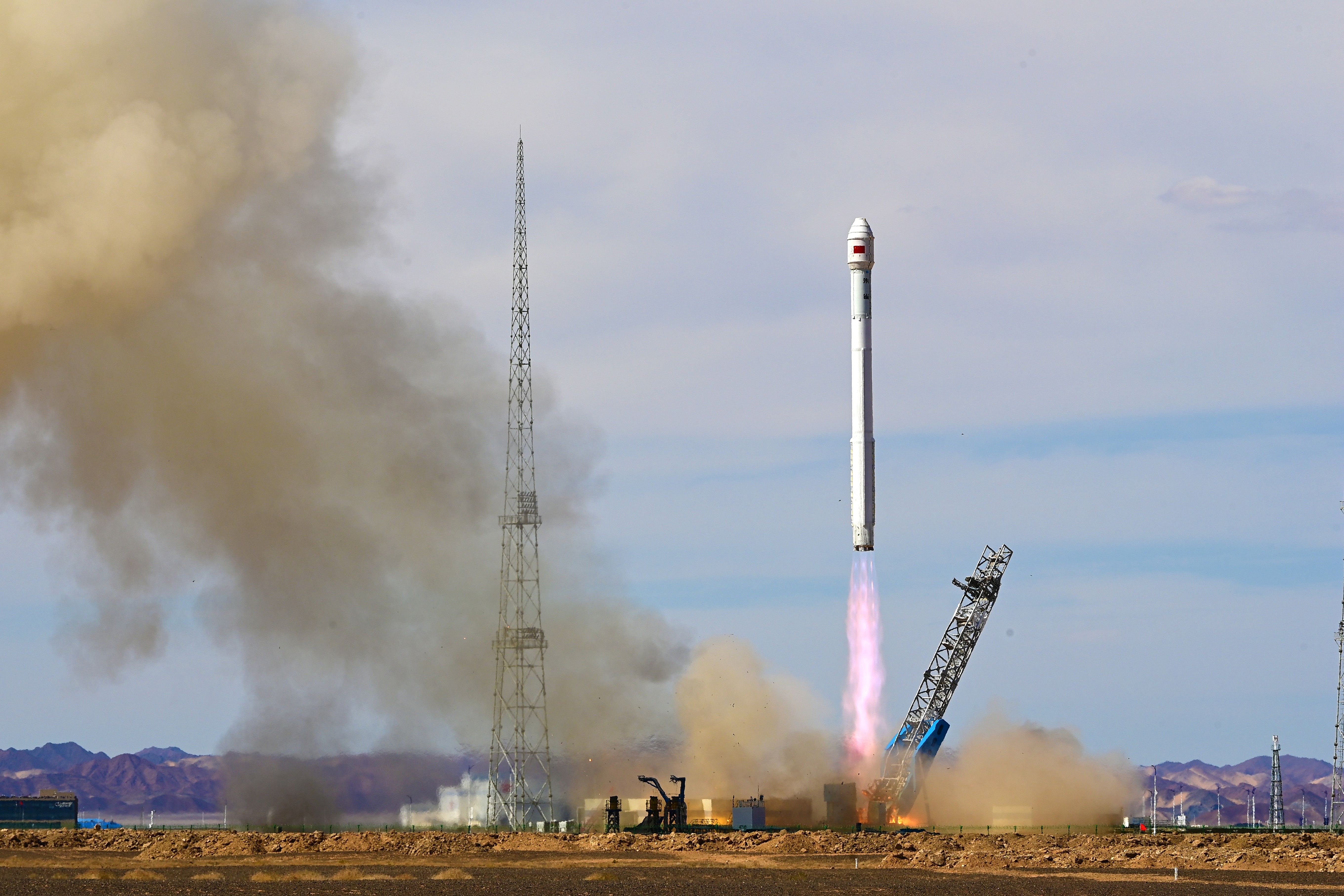
A Minnesota farmer combining his cornfield for the fall harvest found a circular metal object roughly 11 feet across sitting in his field in Scott Township, in west-central Stevens County. Deputies who responded on Wednesday confirmed that a large metallic object, "presumably a space object," had come down in the cornfield. Its diameter matches the upper stage of a Chinese Zhuque-2E rocket that reentered over the American Midwest on September 15.
The rocket, built by the Chinese company LandSpace, lifted off from Dongfeng, a commercial launch zone at the military-run Jiuquan Satellite Launch Center in northwestern China, carrying ten satellites for Qianfan — the Thousand Sails network, China's counterpart to Starlink. About half an hour into the flight it released its payloads into a circular polar orbit at an altitude of roughly 560 miles, then fired its engine again to slow itself out of orbit. The stage flew south from China, over Antarctica, and back north over the Americas; social media captured fiery streaks heading north over Kansas toward Minnesota, visible on the western horizon from Wisconsin. The entire flight lasted between 75 and 80 minutes — the hardware fell from space the same day it left China.
Deorbiting a spent stage is generally considered responsible practice, the point being to limit debris in orbit. But the burn was unguided, and where the metal came down was left to ballistics. American rockets on low-Earth orbit missions usually reserve propellant for guided disposal; Chinese rockets have a record of unguided reentries and in-orbit breakups. This time the ballistics favored a cornfield.
Under international law, the country that launches an object into space is liable for any damage it causes on the ground. The 1972 Liability Convention was written for exactly this situation, and it has yet to produce a paid claim. No one has ever been seriously injured by falling space junk, though property damage has occurred; the Minnesota find is unusual mainly for its size, larger than most objects that survive reentry.
The pace behind the incident is the number that matters. China has launched 258 Qianfan satellites since 2024, toward an initial constellation of 1,296 and longer-term ambitions of more than 15,000. Every one of those launches ends with a spent stage, and each deorbit burn selects a corridor for the hardware to fall through. This one ran over the American Midwest, and the risk landed — without injury — in a cornfield in Scott Township.
The sheriff's office said the debris posed no danger to the public, and is working with several state and federal agencies to identify and notify the owner of the debris and to plan for its removal from the field. None of those agencies are Chinese.