
US courts Myanmar's junta over rare earth minerals
Direct talks upend nearly a decade of western policy, Roger Stone now lobbies for the general blamed for the Rohingya genocide
Images
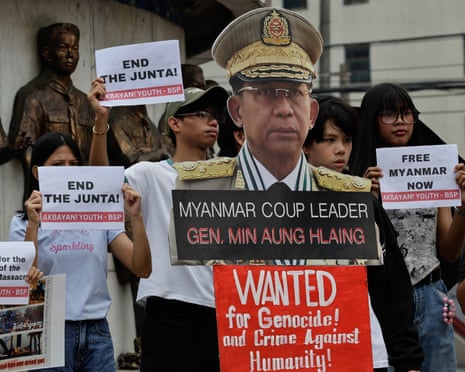 Protesters opposed to the military junta in Myanmar at a rally in Quezon City, Philippines, 11 April 2025. Photograph: Rolex dela Peña/EPA
theguardian.com
 Steve Bloomfield
theguardian.com
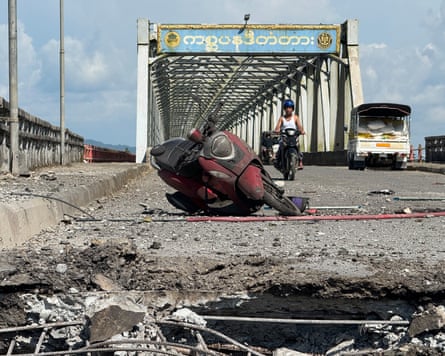 The aftermath of a military airstrike on a market and the Kisapanadi bridge in Rakhine, western Myanmar, 28 September 2026. Photograph: AFP/Getty Images
theguardian.com
The Trump administration has opened direct talks with Myanmar's military regime, a move that stunned other western governments, who were given no advance warning, and that has put the lifting of sanctions on the table, the Guardian reports.
Michael Vance, the assistant secretary of state for intelligence and research, travelled to the junta's capital Naypyidaw this month. The stated purpose of the trip was securing the release of an American citizen. The substance of the conversations, according to the Guardian, was Myanmar's rare earth minerals — not restoring democracy, and not ending the war.
Myanmar holds more than 600 rare earth mines, and the competition for such minerals has hardened as China has come to control most of the world's mines and almost all of its processing capacity. The administration has already struck minerals deals with Ukraine and the Democratic Republic of Congo.
Across the table sits Min Aung Hlaing, who became president after elections in 2025. In 2021 the military arrested Aung San Suu Kyi, overturned her party's election victory and took full control of the country, setting off a civil war of overlapping conflicts between the army, resistance forces and ethnic militias. Around 100,000 people have been killed and five million forced from their homes. The UN estimates that 16 million people in Myanmar need urgent assistance.
In 2017 Marco Rubio — now secretary of state — was one of 21 US senators who signed a letter demanding "strong multilateral sanctions against specific senior Burmese military officials associated with the gross human rights abuses". The letter described the treatment of the Rohingya as ethnic cleansing and argued that those responsible should be prosecuted. Min Aung Hlaing was one of its targets. The treatment of the Rohingya is now widely viewed, including by the US government, as genocide. According to the Guardian, Rubio no longer believes Min Aung Hlaing should be prosecuted; the administration would prefer him as an ally.
The regime has also acquired an American lobbyist. Roger Stone — found guilty in 2019 of lying to Congress, witness tampering and obstructing the investigation into whether the Trump campaign conspired with Russia, and spared prison when Trump commuted his sentence — recently began working for the junta, helping to "rebuild relations between the Republic of the Union of Myanmar and the United States".
The stated purpose of the Naypyidaw trip was one imprisoned American. The rest of the agenda, the Guardian reports, was minerals.