
Fires rise across Africa's tropical forests
Satellite analysis finds significant increases across a third of the Democratic Republic of the Congo, the world's largest tropical carbon sink faces a potentially record El Niño as aid cuts reach its fire programmes
Images
 (The Independent)
The Independent
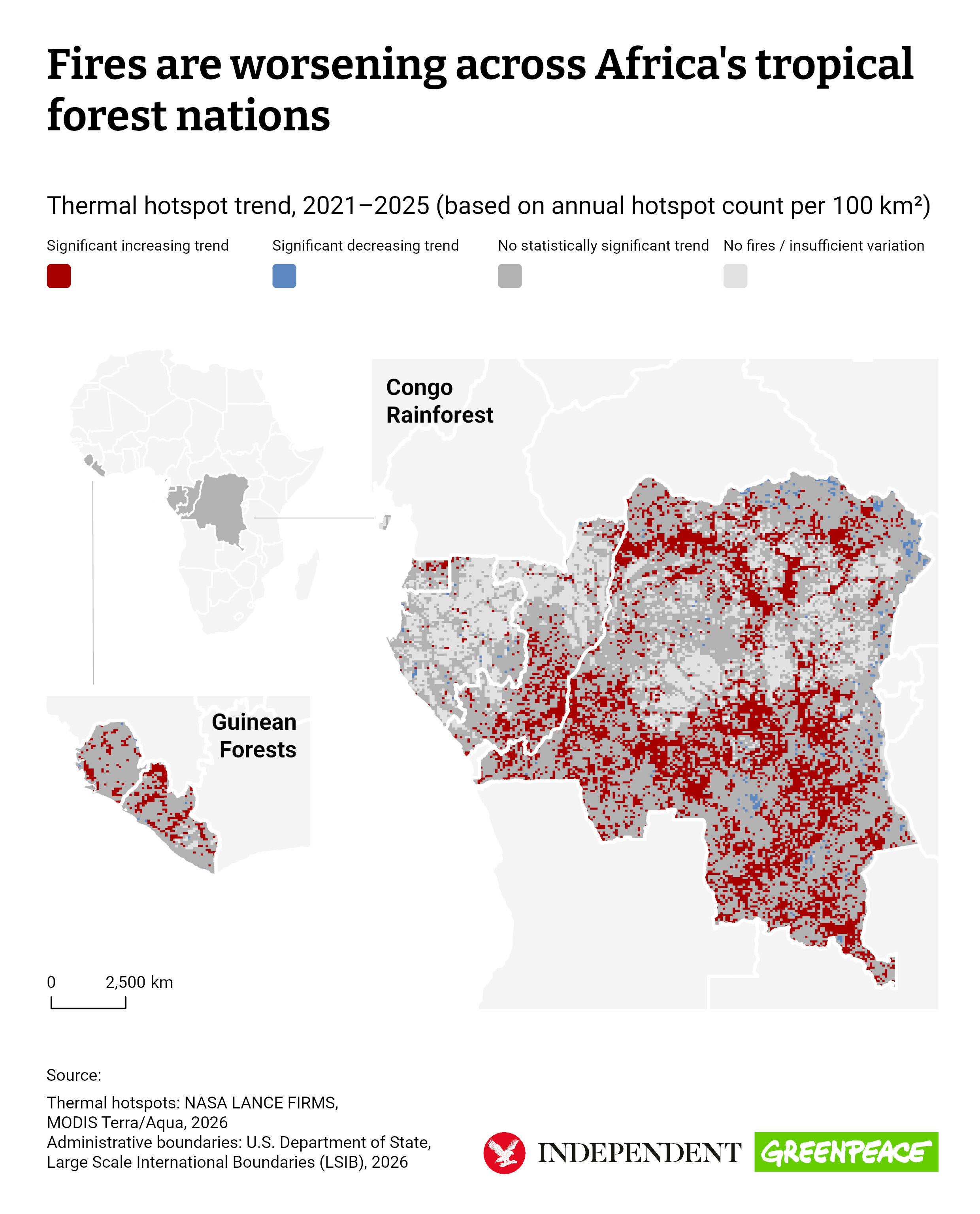
Fires are rising across Africa's tropical forests. An analysis by Greenpeace's Global Mapping Hub, modelling satellite-detected fire hotspots from 2001 to 2025, finds many more areas with significantly increasing fire activity than areas in decline. In the Democratic Republic of the Congo, which holds roughly 60 per cent of the Congo Basin's forests, around a third of the country shows a significant rise when the land is divided into 100-square-kilometre cells; some of the burning falls outside forest, much of it inside.
The Congo Basin is the world's best-preserved major rainforest and the largest remaining net carbon sink in the tropics. Between 2015 and 2024 it removed an average of 160 million tonnes of carbon dioxide-equivalent per year, roughly the emissions of Nigeria. Jean Bakouma, country manager for the World Resources Institute in the Republic of Congo, says forest loss in parts of the basin remains "stubbornly consistent" and that fire is an increasingly important driver: when primary forest and peatland burn, the stored carbon goes with them, and the basin risks flipping from sink to source.
West Africa's Guinean Forest has already lost around 90 per cent of its original cover to logging, agriculture, mining and climate change. In Liberia and Guinea, which hold the last substantial stretches of it, more cells show rising fires than falling ones. A potentially record-breaking El Niño is raising concerns about extreme weather into 2027.
The asymmetry is geographic. The burning concentrates where the response budgets are thinnest — foreign aid cuts from the US and other donors now threaten funding for climate research and the fire-fighting programmes that exist at all. Boreal forests get the headlines and the research stations; the Congo's fires are counted from orbit, on a ground-truth record far thinner than the forests that dominate global carbon accounting.
Cameroon recorded its highest forest loss in 2025, the DRC in 2024. The satellites that noticed are paid for elsewhere.