
San Clemente beaches wash into the Pacific as El Niño season begins
Billion-dollar coastal rail line shut seven times since 2021, California towns weigh seawalls against managed retreat while 2028 Olympic surf venue erodes nearby
Images
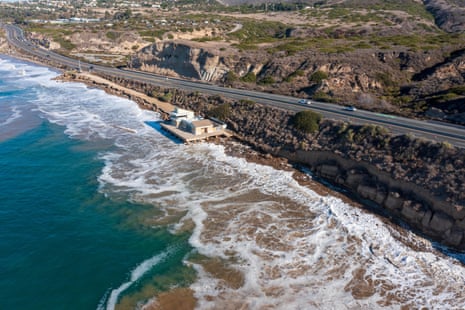 A portion of the southern California coast showing damage from unusually high surf on 14 October 2026. Photograph: Ruaridh Stewart/ZUMA Press Wire/Shutterstock
theguardian.com
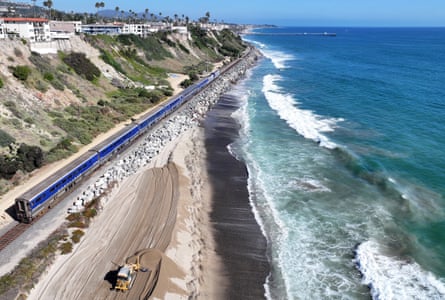 An Amtrak Pacific Surfliner train passes a worker moving fresh sand during an emergency replenishment project on 15 August 2024 in San Clemente, California. Photograph: Mario Tama/Getty Images
theguardian.com
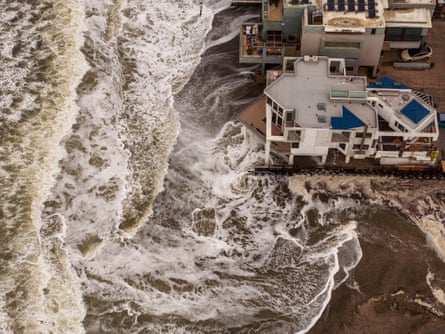 Waves crash into damaged homes as a powerful ocean surge and high tides generated by Tropical Storm Rachel batter the southern California coastline on 11 October 2026 in the Capistrano Beach community of Dana Point, California. Photograph: David McNew/Getty Images
theguardian.com
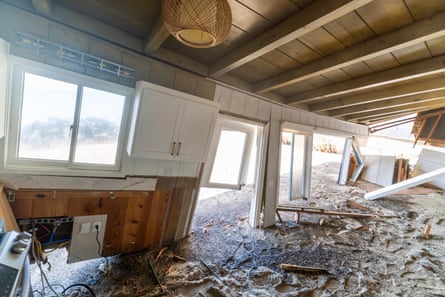 An oceanfront home shows extensive damage from powerful swells generated by Hurricane Marie. The home was eventually demolished. Photograph: Allen J Schaben/Los Angeles Times/Getty Images
theguardian.com
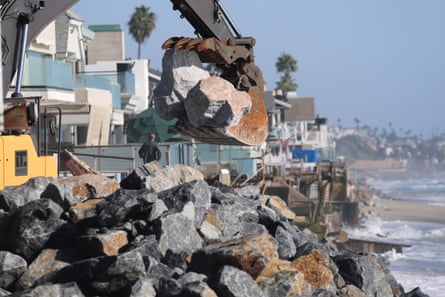 Heavy machinery adds boulders to the protective sea wall along Beach Road in Capistrano beach on 29 September 2026. Photograph: Allen J Schaben/Los Angeles Times/Getty Images
theguardian.com
San Clemente, the southern California surf town that has anchored American surf culture since the 1950s, is watching its beaches wash into the Pacific. Late-summer storms have driven waves against the coastline all season, and towns from Dana Point and Long Beach to Malibu have sustained dramatic damage in what residents describe as a crisis year.
The stakes extend beyond sand. The major regional rail line running along the edge of the ocean in San Clemente carries a billion dollars in freight a year and is the nation's second-busiest passenger line. Severe waves and high tides at the beginning of September overtopped the tracks and forced repeated closures — the line has now been shut seven times since 2021 for repairs after landslides and surging tides in San Clemente and further south.
On the south side of town, swimmers and sunbathers walk over the rail line to reach a narrow strip of sand at the state beach that descends steeply into the water. "You can see, when it gets steep like this, then you're just at a game of attrition," Cameron Cosgrove, a local beach restoration activist, told the Guardian. "It's just a matter of time before the next big wave event will start moving and start taking some of this."
The season is only beginning. A potentially historic El Niño is overlapping with a massive surge of warm Pacific water known as a Kelvin wave. "We're in for a run of pretty exceptional erosion events if this Super El Niño develops as it's expected to," said Sean Vitousek, an oceanographer with the US Geological Survey. Hallie Jones, mayor pro tem of neighboring Laguna Beach, put it more bluntly: "We've been anticipating rising sea levels 50 years from now. This summer proved that sea level rise is already here."
The town's beaches are also on the Olympic calendar — 2028 surfers will compete at Lower Trestles nearby. In the meantime, the choice facing residents is the one every eroding coast eventually confronts: pay endlessly for sand and seawalls to protect mortgaged beachfront property, or move the infrastructure back. President Trump, for his part, continues to call climate change a hoax. The commuter rail posted a video of sediment crumbling off the tracks into the sea.