
Airstrike kills at least 114 goldminers near Sudan's Egyptian border
Cairo confirms campaign against illegal mining but not the strike itself, miners who dug graves for their colleagues say they will return because the pits are their only income
Images
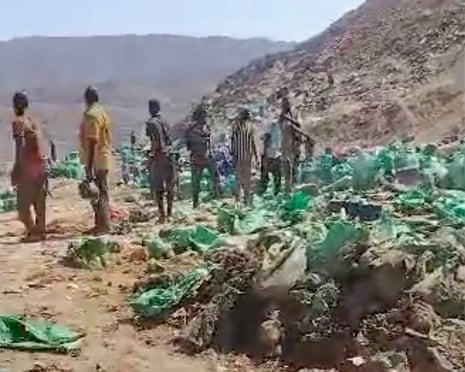 People inspect the site of an airstrike in the mining area of Jabal al-Uqaydat in Sudan, near the Egyptian border. Rights groups say the bombing on 10 October killed 114 people. Photograph: AFP/Getty Images
theguardian.com
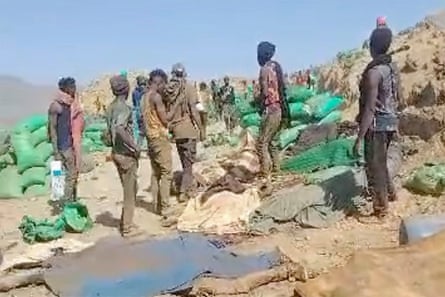 The aftermath of the airstrike in the North Valley earlier this month. Photograph: AFP/Getty
theguardian.com
An airstrike on an artisanal goldmine in Sudan's Jabal al-Uqaydat mining area, near the Egyptian border, killed at least 114 people on 10 October, according to the Sudanese rights group Emergency Lawyers. The site, known as the North Valley, was full of young Sudanese who had come to dig for gold by hand.
Sudan's economy has been shattered by three years of war, and many of the miners had travelled slowly from conflict-hit regions such as Darfur and Kordofan until the only work left was prospecting at the border. When the strike landed, the miners mounted their own rescue: torches still fixed to their heads, they made stretchers from blankets, loaded the wounded into pickup trucks, and began digging graves for the dead. 'These are people who have just come here to earn a living, through their own hard work,' said Ammar, a gold trader who answered calls to help the survivors and whose name is a pseudonym. 'Sudan doesn't have jobs, so they go to the mountains and dig with their hands to live.'
The miners immediately blamed Egypt. Egypt's military has confirmed operations meant to end 'illegal goldmining in the eastern desert', though it has not addressed the airstrike. Egyptian forces have raided the area before, arresting miners and confiscating equipment, and say they distributed leaflets warning civilians to leave — one such leaflet, in photos circulating on social media, reads: 'Surrender yourselves and your equipment. Your lives are more important than any equipment.' Sudanese media reported that Egypt struck the same site in June, killing at least 15 people. Mohamed Salah, director of Emergency Lawyers, said scuffles broke out before the bombing between miners and Egyptian security forces trying to clear the area, and that while Egyptian authorities have long sought to curb illegal border trade, locals did not anticipate an escalation involving military aircraft.
Most of the miners have dispersed since the attack, but Salah does not expect them to stay away. 'The miners say they will return — artisanal goldmining in these border areas is the only source of income for them.' The anger in Sudan is aimed both at what is seen as aggression by the country's northern neighbour against workers who produce much of the gold consumed regionally, and at a Sudanese state unable to defend them.
Egypt dropped leaflets telling the miners their lives were worth more than their equipment. The miners say they will go back.